
Forex trading is legal in Spain, but only through firms that are authorised to serve clients there. According to the CNMV’s own FAQ, that means investment firms authorised and supervised by the CNMV, or recognised foreign entities passporting their services into Spain under EU rules. The currency market itself is not regulated. The firms that offer it to the public are. This guide explains who regulates Spain forex, how to check a broker, which leverage limits and advertising rules apply, and what the evidence says about retail losses.
This is an educational article, not investment advice. Leveraged products can lose you more than you put in. Authorisation in one country does not automatically apply in another, so always confirm the entity that will actually hold your account.
TL;DR
- Forex is legal in Spain when offered by a firm authorised by the CNMV or passporting into Spain under EU rules.
- Check any broker in the CNMV’s official registers and its warnings tool before you deposit anything.
- Retail leverage is capped under ESMA measures (30:1 on major currency pairs), and Spain bans advertising of CFDs to retail clients.
- The CNMV’s own data showed 82% of retail CFD investors lost money in a 2015 to 2016 study period.
- Tax treatment depends on your residence. Confirm it with the Spanish tax authority or a qualified adviser.
Table of Contents
- Is forex legal in Spain?
- Who regulates forex brokers in Spain?
- How to check a forex broker in Spain
- Leverage limits and protections for retail clients
- Spain’s CFD advertising ban
- The risks, with numbers
- What to compare when choosing a forex platform
- Taxes on forex in Spain
- How we approach Spain forex at EuroGain
- Compare regulated brokers with EuroGain
- A step-by-step route for a first-time trader in Spain
- FAQ
- Sources
Is forex legal in Spain?
Yes. The CNMV (Comisión Nacional del Mercado de Valores) describes the forex market as the international foreign exchange market. It is decentralised, has no physical location and is not an organised market. Prices are agreed directly between buyer and seller. The market itself is not regulated, but the offer of these products by financial intermediaries is regulated.
That distinction matters in practice. You are free to speculate on currencies, but the company offering you the account must hold the right permissions. The CNMV states that only entities authorised to provide investment services can offer currency swaps, currency forwards or other OTC currency products to investors in Spain.
The legal framework
Three layers apply:
- Spanish law. Ley 6/2023 on securities markets and investment services was published in the Boletín Oficial del Estado on 18 March 2023. It covers investment firms domiciled in Spain and third-country firms providing investment services in Spain, whether through a branch or under the freedom to provide services without one.
- EU law. MiFID II (Directive 2014/65/EU) and MiFIR (Regulation EU 600/2014) form the EU framework for financial markets in Spain. MiFID II sets the conditions for authorising and running investment firms, including freedom of establishment and freedom to provide services across the EU.
- ESMA and CNMV product measures. These cap leverage, restrict marketing and require risk warnings. We cover them below.
If you are reading from the UK, note that this article describes the Spanish and EU position only. UK-based traders are under a different regulatory regime, and a firm’s permission to serve one market does not carry over to another.
Who regulates forex brokers in Spain?
The CNMV is the supervisor for securities markets and investment firms in Spain. A broker can reach Spanish clients in two main ways:
- Spanish authorisation. The firm is authorised and supervised by the CNMV and appears in its register.
- EU passporting. A firm authorised in another EU member state serves Spanish clients under freedom of services or through a branch. Its home regulator is the primary authority, and the CNMV still polices marketing in Spain.
A third group is firms with no permission at all. These often use a foreign licence, an offshore registration or a vague “regulated” claim on the homepage. A licence from a distant jurisdiction is not authorisation to serve Spain, and a Spanish-language website proves nothing.
How to check a forex broker in Spain
The CNMV gives investors a clear route. Its page on authorised bodies points to the official registers, the “Advertencias al público” tool for unauthorised entities and IOSCO warnings issued by other countries’ supervisors.
A practical checklist:
- Identify the legal entity. Find the company name, registered office and registration number in the broker’s terms and conditions, not just the brand name. Many brands operate through several entities in different countries.
- Search the CNMV register. The Official Register of Broker-Dealers and Brokers lists the registration number, full name, registered office, shareholders, directors, branches and representatives, audited accounts, and the fees and commissions charged to clients.
- If it is not listed, look for warnings. The CNMV’s Investor’s Decalogue advises checking whether the CNMV or other supervisors have warned about the entity. If you are still in doubt, call the CNMV investor helpline on 900 535 015 (a Spanish number).
- Check the passport if it is a foreign EU firm. Confirm the home regulator’s register entry and that the entity names Spain among the countries it serves.
- Check any sales agent. The same Decalogue advises that agents must be registered with the CNMV or the Banco de España. They cannot receive money or financial instruments from you, even temporarily, and cannot take fees or commissions from you.
If any of those steps fail, do not deposit. That is a safety rule, not a matter of taste.
Leverage limits and protections for retail clients
Retail clients in the EU, including Spain, are covered by ESMA’s product intervention measures. According to ESMA’s FAQ, the package includes leverage limits, a per-account margin close-out rule, negative balance protection, a ban on trading incentives and a standardised risk warning.
The leverage limits by underlying are:
| Underlying | Maximum leverage (retail) |
|---|---|
| Major currency pairs | 30:1 |
| Non-major currency pairs, gold, major equity indices | 20:1 |
| Other commodities, non-major equity indices | 10:1 |
| Individual equities and other underlyings | 5:1 |
| Cryptocurrencies | 2:1 |
What this means in plain terms: at 30:1, a position worth €30,000 needs €1,000 of margin. A 3.3% move against you would wipe out that margin. The close-out rule exists to stop positions running on after that point, and negative balance protection is designed to prevent a retail client losing more than the account holds. For a deeper explanation of margin calls and close-outs, see our guide to forex margin, leverage and close-outs, and our look at how European leverage rules work.
Be careful with brokers that offer much higher leverage to “professional” status. Professional clients lose some of these protections. Our overview of professional forex accounts sets out what to check before you consider that route.

Spain’s CFD advertising ban
Most retail forex in Europe is traded as a CFD, so Spain’s rules on CFDs matter to anyone searching for Spain forex. The CNMV’s Resolution of 11 July 2023 prohibits advertising of CFDs to retail investors or the general public in Spain and adds investor protection measures for CFDs and other leveraged instruments.
Two points often get missed:
- It covers advertising, not trading. According to the CNMV’s Q&A on the Resolution, the ban applies to advertising in Spain regardless of where the client lives. The sale of CFDs is still allowed when it is carried out at the sole initiative of the investor. The Resolution applies to all retail clients in Spain, including non-residents.
- It reaches foreign firms. Luxembourg’s regulator confirmed that entities it supervises are barred from advertising, sponsoring events and certain marketing practices when selling CFDs to retail investors in Spain, effective 3 August 2023.
The Resolution also goes beyond CFDs. It covers other leveraged instruments where the maximum amount at risk is unknown at subscription or exceeds the amount initially invested. Purchased options and warrants are excluded, because the risk is limited to the known premium.
A practical consequence: if a broker is heavily promoting CFD accounts to you in Spain, through ads, influencers or sponsorships, ask why. We explain how the products differ in our CFD trading vs forex guide.
The risks, with numbers
Retail forex and CFD trading is high-risk. The CNMV’s CFD information sheet warns that these leveraged products can cause losses larger than the capital invested. It says beginners should understand how they work, have time to monitor positions systematically, consider overnight costs and assess their ability to bear losses.
The CNMV has also published data. In a study covering January 2015 to September 2016, 82% of investors who traded CFDs made a loss. The total losses of 30,656 investors came to €142 million: €52 million in trading losses plus €90 million in fees, spreads and other costs. Note the second figure. Costs alone were larger than trading losses.
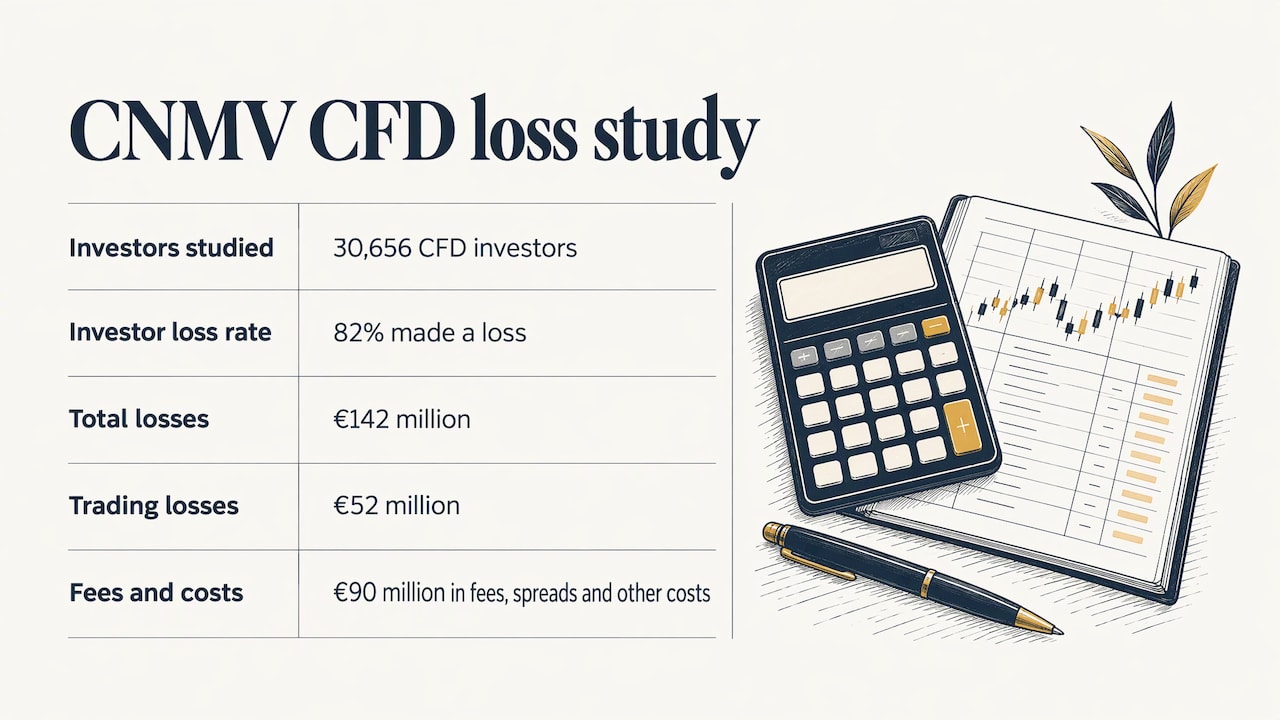
In its 2023 Resolution, the CNMV said CFDs remain the main derivative product marketed to retail clients in Spain, that they are generally unsuitable for this type of investor, and that recent analyses show a high percentage of retail clients still lose money. This is old data from one country, and results vary by period and trader. But it is the regulator’s own evidence, and it is a sound reason to treat forex as a risk you can afford, not an income plan.
Risks beginners tend to underestimate
- Leverage cuts both ways. It magnifies losses as much as gains.
- Costs compound. Spreads, commissions and overnight financing are charged whether or not the trade works.
- Execution can differ from the quote. In fast markets, such as around major data releases, the price you receive can be worse than the price you saw.
- Time and attention. Open positions need monitoring, and a margin close-out can happen while you sleep.
- Behaviour. Adding to a losing position to win back losses is the quickest route to a larger loss.
What to compare when choosing a forex platform
Once a broker passes the authorisation check, compare it on the factors that change your outcome.
| Criterion | What to look for | Where to verify |
|---|---|---|
| Authorisation | Named legal entity, register entry, Spain covered | CNMV register or home regulator |
| Total cost | Spread, commission, overnight financing, inactivity and withdrawal fees | The broker’s fee schedule and terms |
| Client protection | Negative balance protection, segregated client funds, compensation scheme details | Terms and regulator information |
| Leverage and margin | Limits per instrument, margin close-out level | Product terms |
| Execution | Order types, execution policy, how slippage is handled | Order execution policy document |
| Deposits and withdrawals | Methods, limits, processing times, fees | Payment terms |
| Support | Languages, hours, channels | Published support terms |
On costs, the CNMV’s FAQ explains that authorised firms’ commissions are unrestricted but must be listed in a detailed tariff brochure registered with the CNMV, and clients must be told the total price including fees, commissions, costs and associated taxes. Read that document before you fund an account, and compare it with the marketing page, not the other way round.
If you also want to use copy trading or signal services, our checklist on what to check with copy trading providers applies the same authorisation-first logic.
Worked example: reading costs
Suppose you trade one standard lot (100,000 units) of a major pair and the broker’s spread is 1.0 pip. On a EUR-denominated pair, a pip on a standard lot is worth about €10, so the spread costs about €10 on entry before the price has moved at all. Hold the position for several days and overnight financing is added. Trade ten times a month and costs run to about €100 before any commission. This is an illustration of the arithmetic, not a quote from any broker. Your actual figures come from the broker’s own fee schedule.
Taxes on forex in Spain
Tax treatment depends on whether you are a Spanish tax resident, the type of product and how your gains and losses are reported. Many commentary sites say gains are treated as capital gains in the savings base of personal income tax (IRPF), but we do not publish rates here, because they change and the figures we found came from non-official sites. Confirm the current rules and thresholds with the Agencia Tributaria or a qualified Spanish tax adviser. If you live elsewhere, such as the UK, your own country’s tax rules apply, and a local adviser is the right person to ask.
Keep complete records from the start: trade confirmations, statements, deposits, withdrawals and fees. They will be needed whichever way you are taxed.
How we approach Spain forex at EuroGain
Our view is simple: a broker’s marketing tells you what it wants you to believe, and its regulatory entry tells you who answers if something goes wrong. We begin every assessment with the legal entity, the regulator and the jurisdiction, and we never assume that permission in one country covers another.
We want readers to see the evidence behind a ranking. Our rankings are independent editorial judgements, and we do not let commissions or sponsored placements decide them. Where a listing is paid for, it is labelled and kept separate from our reviews. We prefer official documents, such as regulator registers, broker terms and fee schedules, to anything a brand says about itself.
We also think the honest message about leveraged products is the useful one. Forex is a high-risk activity, regulators’ own data show most retail clients lose, and no review of ours will promise otherwise. If you trade, use only money you can afford to lose, understand the margin rules first and treat a broker’s authorisation check as non-negotiable.
Evan Alexander
Compare regulated brokers with EuroGain
EuroGain Online publishes independent reviews and comparisons of forex brokers and online casinos, covering safety, reliability, fees and product features, plus regularly updated guides. Start with our broker comparison page, or read the broker reviews to see how we assess an operator’s regulation, costs and terms.
A note on how we earn money: EuroGain earns referral revenue when readers click through to operators and complete qualifying actions, and it also carries clearly labelled sponsored placements. Neither changes our rankings or conclusions. Our affiliate disclosure explains this in full, and our risk disclaimer sets out the risks of trading. You must be 18 or over to use these services, and leveraged trading is not suitable for everyone.
A step-by-step route for a first-time trader in Spain
- Decide if it fits. Only money you can afford to lose should be used, and it should never be money needed for rent, bills or emergencies.
- Shortlist by authorisation, not by advertising. Use the CNMV register and warnings tool as described above.
- Read the legal documents. Terms, fee schedule, order execution policy and risk warning, in the language you understand best.
- Compare total costs. Use the table above, and work out a realistic monthly cost for your expected trading frequency.
- Set rules before you trade. Decide a maximum loss per trade and per month, and keep to it. Never add to losing positions to recover losses.
- Start small and keep records. Small position sizes limit the damage while you learn how margin and spreads behave.
- Re-check periodically. Registers and warnings change, so confirm that your broker’s status is still valid.
If trading is causing you stress, or you are chasing losses, stop and speak to a qualified professional or a financial support service in your country.
FAQ
Is forex legal in Spain?
Yes. Forex trading is legal in Spain when it is offered through firms authorised by the CNMV, or recognised foreign firms passporting into Spain under EU rules. The currency market itself is not regulated, but the firms offering retail products are.
How do I check if a forex broker is allowed to serve Spain?
Search the CNMV’s official registers for the legal entity, and use its “Advertencias al público” tool to look for warnings. If the firm is not listed and you are unsure, the CNMV investor helpline is 900 535 015. Treat a missing entry as a reason not to deposit.
What is the maximum leverage for retail forex traders in Spain?
Under ESMA’s product intervention measures, retail leverage is capped at 30:1 for major currency pairs and 20:1 for non-major pairs, gold and major equity indices. Lower caps apply to other underlyings, down to 2:1 for cryptocurrencies. Professional clients are treated differently and lose some protections.
Can CFDs be advertised in Spain?
No. The CNMV’s 2023 Resolution prohibits advertising CFDs to retail investors or the general public in Spain. Trading is still permitted when it is executed at the investor’s sole initiative.
Is forex trading a reliable way to make money?
No. The CNMV’s study of January 2015 to September 2016 found that 82% of retail CFD investors lost money, and its 2023 Resolution says a high percentage of retail clients continue to lose. Treat it as a high-risk activity and never rely on it for income.
Sources
- CNMV: Preguntas y respuestas (FAQ)
- BOE: Ley 6/2023 on securities markets and investment services
- CNMV: MiFID II and MiFIR
- CNMV: Who are the authorised bodies?
- CNMV: Official Register of Broker-Dealers and Brokers
- CNMV: Decálogo del Inversor, Consejo 1
- ESMA: FAQ on product intervention measures
- CNMV: Resolution of 11 July 2023 on CFDs
- CNMV: Q&A on the CFD Resolution
- CSSF: CNMV product intervention measures on CFDs
- CNMV: Los contratos por diferencias (CFD)
- CNMV: Measures on the marketing of CFDs
Recommended
- Forex Broker Review: Saxo Bank UK Costs and Risks
- XM Stable Leverage: European Rules and Risks
- eToro Forex Broker Review: Safety, Fees and Risks
- Pepperstone Forex Broker Review: UK Costs & Risks
Editorial Disclaimer: This article is provided for general informational and educational purposes only and does not constitute financial, investment, legal, or gambling advice. Where relevant, gambling is intended only for adults aged 18 or over, or the higher legal age in their jurisdiction, and involves a risk of financial loss. Forex and CFD trading involve a high risk of loss, particularly when leverage is used. Regulations, product availability, fees, and promotional terms may vary by juris