

No roulette betting strategy changes the odds. Every spin is independent, and the casino’s built-in edge applies to each bet however you stake it. A strategy can shape how you play: how big your bets are, how long a session lasts and when you stop. It cannot make the game profitable. Used well, it keeps the game affordable. Used badly, it turns a small loss into a large one.
This guide is for beginners and for players who want to know what the common systems do. It covers the maths, a worked Martingale example, the bets worth knowing, and a simple routine for setting limits. Roulette is for adults only (18+), and it should be treated as paid entertainment, never as a way to earn money.
TL;DR
- No system beats the house edge: 2.7% on a European wheel and 5.26% on an American wheel in the casino’s favour over time.
- Progression systems such as Martingale change your stake after each result, not the odds. A table limit or an empty bankroll can stop them at the worst moment.
- If you play, choose a single-zero (European) wheel, use flat stakes on even-money bets and decide your loss limit before the first spin.
- Never chase losses. “Keep going until it wins” is not a plan.
- If gambling stops being fun, stop and contact GamCare or your local support service.
Table of Contents
- Why no roulette strategy beats the house edge
- European, American and French wheels compared
- The bets: what you can place and how often they win
- How the common roulette betting systems work
- A sensible approach for beginners
- Bonuses and roulette: read the terms
- What to look for in a roulette site
- Our view: strategy is about budget, not beating the wheel
- Find a licensed casino before you play
- Responsible play
- FAQ
- Sources
Why no roulette strategy beats the house edge
A roulette wheel has no memory. A European wheel has 37 pockets, numbered 0 to 36. The casino pays winning bets as if there were only 36, and the single zero is where its advantage comes from. Over many spins, the casino keeps about 2.7% of the money wagered on a European wheel, according to a paper in the Royal Statistical Society’s Significance magazine.
An American wheel adds a second zero, giving 38 pockets. That roughly doubles the long-run cost to 5.26%. The same article makes the central point: because each spin is independent and the wheel is not biased, the casino wins in the long run whatever betting pattern you use.
It helps to read the house edge as a price. Stake £100 in total across many spins on a European wheel and the average cost is £2.70. On an American wheel it is £5.26. That is an average over a very large number of spins. In one session you can win or lose far more than the average, which is why the short term feels different from the long term.
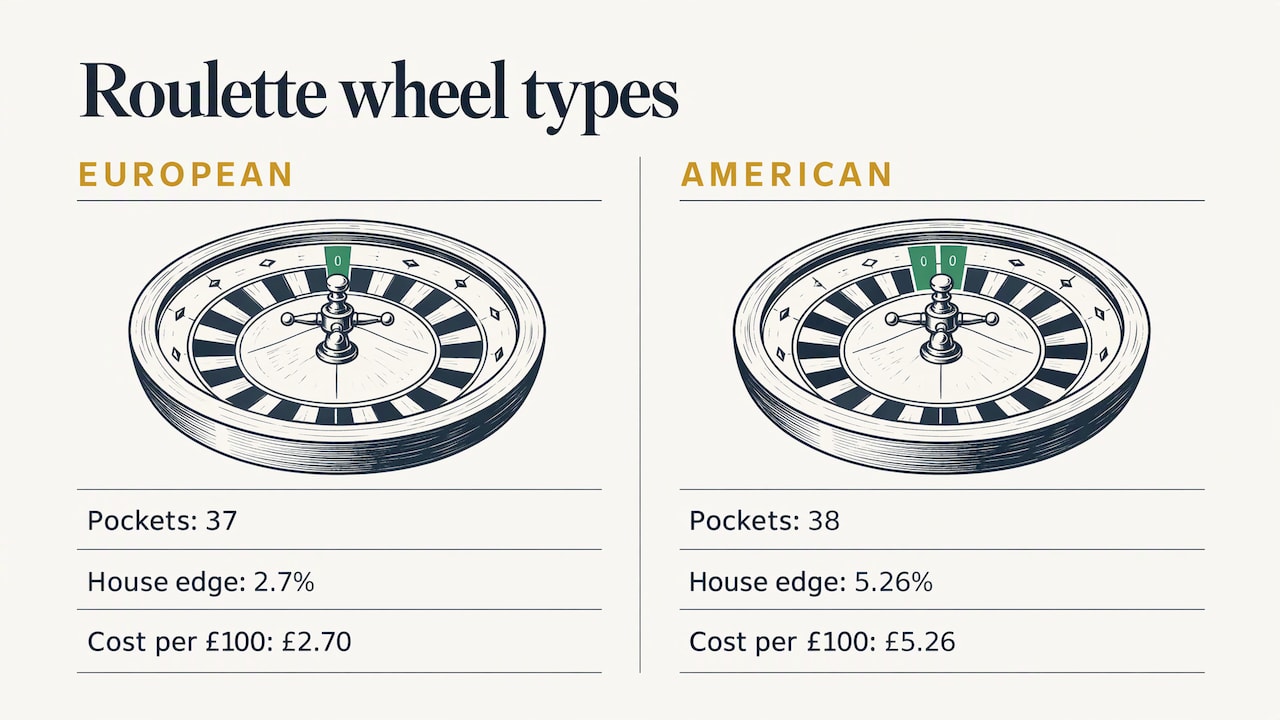
This is also why the claim “I have a system that wins” should not be trusted. A system changes how much you stake next. It does not change the probability of the next spin. If every single bet has a negative expected value, a sequence of those bets has one too.
European, American and French wheels compared
The wheel you choose matters more than any staking pattern. It is the one decision that changes the cost of playing.
| Wheel | Pockets | House edge | What to know |
|---|---|---|---|
| European (single zero) | 37 | 2.70% | The standard choice for UK players and beginners |
| American (double zero) | 38 | 5.26% | About twice the long-run cost of European |
| French or “half-back” tables | 37 | Lower on even-money bets | Some casinos return half your stake when zero lands, which effectively halves the edge on those bets |
Rules differ between casinos and between tables, so check the rules shown on the game screen or in the operator’s terms before you play. If a table offers the half-back rule on even-money bets, it is the cheapest roulette you can find. If you are choosing where to play, our checklist for choosing an online casino shows what to confirm first, including the licence and the operator’s legal entity.
The bets: what you can place and how often they win
Strategies are built from a small set of bets. On a European wheel the chance of winning each one is simply the number of winning pockets divided by 37.
| Bet | Pockets covered | Chance of winning (European) | Payout |
|---|---|---|---|
| Red or black, odd or even, 1-18 or 19-36 | 18 | 48.65% | 1 to 1 |
| Dozen or column | 12 | 32.43% | 2 to 1 |
| Six line | 6 | 16.22% | 5 to 1 |
| Corner | 4 | 10.81% | 8 to 1 |
| Street | 3 | 8.11% | 11 to 1 |
| Split | 2 | 5.41% | 17 to 1 |
| Straight up (single number) | 1 | 2.70% | 35 to 1 |
The percentages are calculated from the pocket counts. Two things follow from the table. First, the payouts are set so that every bet carries the same house edge on a given wheel. A single-number bet is not “worse” than red or black in cost per pound staked. It is more volatile: you win rarely, but when you do the win is large. Second, the zero is what makes even-money bets slightly less than 50%. When the ball lands on 0, red, black, odd, even, low and high all lose (unless the half-back rule applies).
One exception on American wheels is the five-number basket bet (0, 00, 1, 2, 3), which carries a higher house edge than every other bet on the table. Avoid it.
How the common roulette betting systems work
Most systems fall into two families. Negative progressions raise your stake after a loss. Positive progressions raise it after a win. Both only alter how much you have at risk on each spin.
Martingale
Martingale is the best-known system. After each loss on an even-money bet you double your stake. After a win you go back to the base bet. The aim is to recover all earlier losses plus one base unit when you eventually win.
Here is the worked example, with a £5 base stake on red on a European wheel:
| Spin | Stake | Total staked so far |
|---|---|---|
| 1 | £5 | £5 |
| 2 | £10 | £15 |
| 3 | £20 | £35 |
| 4 | £40 | £75 |
| 5 | £80 | £155 |
| 6 | £160 | £315 |
| 7 | £320 | £635 |
| 8 | £640 | £1,275 |
If the seventh bet wins, you collect £640 against £635 staked: a profit of £5, the same as your first stake. Seven losses in a row sounds unlikely, but red or black loses with a probability of 19 in 37 (about 51.35%) on each spin. Seven consecutive losses therefore happen roughly once in every 106 rounds (about 0.9%). And a Martingale player is exposed to that run every time they start a new sequence.
The real problem is the ceiling. The same paper notes that the system needs a large bankroll, and that a house limit can prevent you placing a large enough recovery bet. If the table maximum is £500, the £640 bet above is not allowed. You are left with a loss of £635 and no way to recover it. You risk a large sum to win a few pounds, and the average cost across all your bets remains the house edge.
Other progressions
- Reverse Martingale (Paroli): you raise the stake after wins and return to the base after a loss. Losses stay small, but a long winning run is needed to make a meaningful profit, and one loss ends it.
- D’Alembert: add one unit after a loss, subtract one after a win. It is gentler than Martingale and still cannot change the odds.
- Fibonacci: step up through the sequence 1, 1, 2, 3, 5, 8 after losses and step back after wins. Stakes grow more slowly than in Martingale, but the same limits apply.
- Labouchere: you write a list of numbers, bet the first and last added together, and cross numbers off after wins. It is a way of tracking a target, not a way of improving the odds.
A useful rule of thumb: the faster a system raises your stakes, the faster a losing streak can drain your bankroll. Simulations that run thousands of sessions on a roulette wheel show the same pattern: the average bankroll falls over time whichever system you use, and faster for those that stake more.
A sensible approach for beginners
If you are new, you do not need a progression at all. You need rules about money and time. Here is a routine that keeps the game within your budget.
- Choose the wheel first. Pick a single-zero European table, and a half-back table if one is available. Avoid American double-zero tables.
- Set a session budget you can afford to lose. This is money that is not needed for rent, bills or savings. Treat it as the price of an evening’s entertainment.
- Size your stake to the budget. A common guideline is to set each betting unit at 1% to 2% of the session bankroll. On a £100 session budget that is £1 to £2 a spin, which gives you many spins of entertainment.
- Use flat stakes on even-money bets. Betting the same amount on red, black, odd, even, high or low gives you the lowest swings and the most time at the table.
- Set a stop-loss before you start. Decide the loss at which you leave, and leave. Some guides suggest stopping at half the session budget.
- Set a time limit too. A predetermined time, loss or number of bets are all valid stopping rules. “Continue until it wins” is not one, because it lets the wheel decide how long and how costly your session is.
- Never chase losses. A bad run does not make a win more likely. The next spin has the same odds as the last.
- Treat wins as a reason to stop, not to raise stakes. If you reach a target you set in advance, leave with the result.
You can also use the deposit limits, time-outs and reality checks that licensed UK operators must offer. Setting them before you play takes away the temptation to change the rules mid-session.
Bonuses and roulette: read the terms
Casino bonuses can look like a way to stretch a bankroll, but they come with conditions. Roulette often contributes little or nothing towards wagering requirements, and some offers exclude it or restrict how much you can stake while a bonus is active. Check the contribution rate, the maximum bet, the expiry date and any withdrawal limits in the offer’s terms. Our pages on casino bonuses, cashback casino bonus terms and why a bigger bonus isn’t always better explain how to read those conditions. A bonus is a conditional offer, not free money.
What to look for in a roulette site
Before depositing, confirm the basics, because they matter more than any staking pattern:
- the operator holds a licence valid for your country, and you can identify the legal entity running the site, as authorisation in one country does not cover another;
- the wheel type and rules (single or double zero, half-back rule) are shown clearly;
- table minimums and maximums suit your budget;
- deposit limits, time-outs and self-exclusion tools are easy to find;
- withdrawal terms and verification steps are stated before you play.
Our casino reviews set out licence, terms and payout details operator by operator, so you can compare them before you register.
Our view: strategy is about budget, not beating the wheel
Readers often come to us hoping for the one system that works. We would be doing them a disservice if we pretended it existed. The maths is settled: the edge sits in the wheel, and staking patterns only decide how quickly you experience it.
What we can do is help you play on the best terms available. That means preferring a single-zero or half-back table, understanding exactly what a bonus requires of you, and choosing an operator whose licence, entity and withdrawal terms you have checked. Those choices have a measurable effect on cost. A progression system does not.
Our rankings are editorial and are not set by commissions or sponsored placements. We earn from referral links and clearly labelled placements, and our affiliate disclosure explains how. We keep those separate from our assessments, so that when we say a site is worth your attention, the reason is on the page.
Evan Alexander
Find a licensed casino before you play
If you have decided to play roulette, the safest first step is choosing the operator carefully. EuroGain Online publishes independent reviews of online casinos and forex brokers, with regularly updated rankings and guides that compare safety, reliability and product features. Featured placements are funded openly and kept apart from editorial rankings.

Start with our casino reviews to compare operators, or browse the EuroGain Online home page for our latest guides. Remember that gambling is for over-18s only.
Responsible play
Roulette should cost you only what you have budgeted for entertainment. Warning signs include playing for longer than planned, raising stakes to recover losses, borrowing to gamble or hiding how much you spend. If any of these apply, stop playing, use your operator’s self-exclusion tools and speak to a support service such as GamCare in the UK. If you are not in the UK, your national gambling helpline will be able to help.
FAQ
What is the best roulette betting strategy for beginners?
There is no winning strategy, but there is a sensible one: play a European single-zero wheel, use flat stakes on even-money bets, and set a loss limit and time limit before you start. This keeps the cost at the lowest level the game allows and keeps sessions short and affordable. Avoid progressions that raise stakes quickly.
Does Martingale work in roulette?
It often produces small wins, but it does not change the odds. Each round risks a large amount to win one base unit, and a long losing run or a table limit can stop you recovering. The strategy needs a large bankroll and still carries the house edge on every bet.
Is roulette 100% luck?
The result of each spin is pure chance. Your decisions are about the wheel you choose, the bets you place, your stake size and when you stop. Those affect the cost and length of your session, not the outcome of any spin.
What is the difference between European and American roulette?
European wheels have one zero and 37 pockets, with a 2.70% house edge. American wheels have a second zero, 38 pockets and a 5.26% edge. The extra zero roughly doubles the long-run cost, so the European wheel is the better choice.
Sources
- Can maths help you win at roulette? (The Conversation)
- Did a Roulette System “Break the Bank”? (Significance, Royal Statistical Society)
Recommended
- Bonuses
- Cashback Casino Bonuses: Terms Explained
- Bigger Casino Bonus: Why Size Isn’t Everything
- How to Choose an Online Casino: A Checklist for UK Players
Editorial Disclaimer: This article is provided for general informational and educational purposes only and does not constitute financial, investment, legal, or gambling advice. Where relevant, gambling is intended only for adults aged 18 or over, or the higher legal age in their jurisdiction, and involves a risk of financial loss. Forex and CFD trading involve a high risk of loss, particularly when leverage is used. Regulations, product availability, fees, and promotional terms may vary by juris