A forex managed account is a trading account in which a professional manager places trades for you in return for a fee. Investopedia describes it as a currency account where the manager trades on the client’s behalf, usually for a percentage of profits. You hand over the trading decisions. You do not hand over the risk. This guide explains the main structures, how fees are calculated, what to check on the FCA register and what can go wrong. It is education, not personal advice.
Forex and CFDs are leveraged products and you can lose some or all of your money. Nothing here promises profit. Disclosure: EuroGain Online earns referral commission from some brokers and carries clearly labelled sponsored placements. These never decide our rankings or conclusions. See our affiliate disclosure.
TL;DR
- A managed account is usually opened in your own name, with a manager authorised to trade it. Check the authorisation covers discretionary management, not only the broker’s licence.
- PAMM pools investors’ money, MAM gives the manager per-account flexibility, and LAMM copies the manager’s lot sizes into separate accounts.
- Fees are commonly a share of profits, sometimes plus an annual management fee. Always read the contract for the high-water mark, the withdrawal rules and any penalties.
- Delegating trades does not delegate losses. Guaranteed or “risk-free” returns are the clearest warning sign.
- In the UK, look up both the manager and the broker on the FCA’s Financial Services Register before depositing anything.
Table of Contents
- How a forex managed account works
- PAMM, MAM and LAMM compared
- What managed accounts cost
- Is it legal and regulated in the UK?
- The risks you carry
- How to check a manager before you commit
- Managed accounts, copy trading and automation
- Our perspective
- Compare brokers before you choose a platform
- FAQ
- Sources
How a forex managed account works
There are two things to separate: who owns the money and who makes the decisions.
In a typical arrangement the account sits at a broker in the investor’s name. The manager is given trading authority, often through a limited power of attorney. ForexFunds.com explains that a trading-only authority lets the manager trade without being able to deposit or withdraw funds. That distinction matters. If a manager asks for authority to move money, or asks you to send money to their personal account, treat it as a stop sign.
Regulators describe the service in similar terms. A discretionary arrangement means the client lets another party make trading decisions, and in the UK the FCA treats discretionary portfolio management as managing a portfolio under a mandate agreed with the client, according to Finansified’s summary of both regimes.
The manager then trades, and the broker’s platform shows you the open positions, balance and history. Many brokers give investors read-only access so you can watch the account without being able to interfere.
PAMM, MAM and LAMM compared
Three technical set-ups sit behind most managed forex accounts. The names matter because they change how much control you have and how your profit is divided.
| Feature | PAMM | MAM | LAMM |
|---|---|---|---|
| Money | Pooled in one master account | Separate investor accounts | Separate investor accounts |
| How trades are allocated | By share of the pool | Manager sets lot or risk per account | Manager’s lot sizes mirrored across accounts |
| Manager flexibility | Full control, one strategy for all | High: can vary risk per investor | Lower: copying follows the manager’s lots |
| Investor control | Limited | Keeps account ownership and monitoring | Can disconnect from the copying service |
| Fee setting | Performance fee on pooled profit | Customisable management and performance fees | Set by the provider’s terms |
The descriptions above follow one industry comparison of PAMM, MAM and LAMM. These are descriptions from industry blogs, so confirm exactly how any specific provider implements them in its own agreement.
What this means in practice
If you want the ability to leave quickly, a structure with separate accounts is easier to exit than a pool, where your money is mixed with other investors’ and withdrawals follow set procedures. If you want a manager to run a different risk level for you than for others, MAM is built for that.
Pooled accounts can also carry extra regulatory weight. One broker-side analysis argues that pooling can push PAMM towards collective investment scheme rules under bodies such as the FCA, while segregated MAM accounts tend to fall under portfolio-management permissions. That is an industry view, not a rule you can rely on. It is a reason to ask the provider which permission it holds and to check the register yourself.

What managed accounts cost
Fees are where two managers with similar returns can leave you with very different outcomes. Common models include:
- Performance fee: a percentage of profits. Investopedia notes fees typically range between 20% and 30% of a trade’s earnings. Other guides quote 15% to 30% of net profits, so treat any range as a rough guide and read the actual contract.
- Management fee: a fixed yearly percentage, often quoted at 1% to 2%, charged whether or not the account makes money.
- High-water mark or hurdle rate: the manager earns a performance fee only on profits above your previous peak, or above a set return. This stops you paying twice for recovering the same losses.
On top of these, you still pay the broker’s trading costs: spreads, commissions and overnight financing. A manager who trades often generates more of these costs. Our guide to raw spread brokers shows how account type changes cost per trade.
A worked PAMM example
One broker’s PAMM documentation gives a simple illustration. Three investors pool $50,000, $35,000 and $15,000, a total of $100,000. The manager charges a 20% performance fee. After a 12.5% gain of $12,500, the $2,500 performance fee is deducted and the remaining $10,000 is split by each investor’s share of the pool.
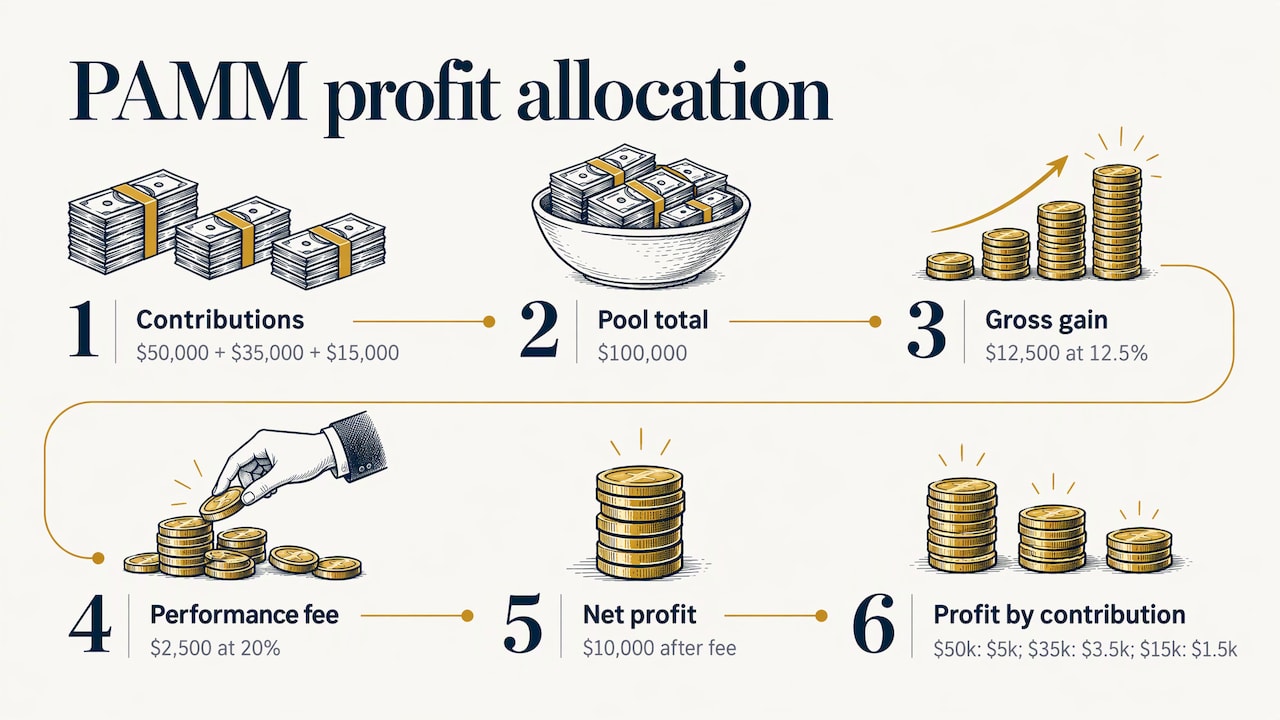
So the investor with half the pool receives $5,000 of the net profit. The example shows the mechanics only. The same fee applies on the way up but a loss is shared in the same proportions, and the example says nothing about how likely a gain is.
Is it legal and regulated in the UK?
Managing someone else’s trading account is a regulated activity in the UK. The FCA says that in the UK nearly all financial services activities must be authorised or registered, and it publishes a public Financial Services Register where you can look up firms and see whether they have been flagged as unauthorised.
A broker’s licence and a manager’s licence are two different things. A regulated broker can host an unregulated manager. In that case the platform may be perfectly legitimate while the person trading your money has no permission to do so. FX Foundations points out that if a manager operates without proper licensing, your funds may have no regulatory protection. The same guide notes that the equivalent authorisation in other jurisdictions comes from different bodies, for example ASIC in Australia and CySEC in Cyprus.
One thing readers often assume wrongly: authorisation in one country does not carry across Europe or the rest of the world for your purposes. Check who the legal entity is, which regulator authorises it and which entity your contract is actually with.
Leverage and compensation
Retail leverage on major currency pairs is capped at 30:1 for UK clients, according to a comparison of leverage limits by regulator. That cap applies to retail clients. Brokers can treat clients as professional on request, with fewer protections, and our page on the Axi professional account covers what that change involves.
Compensation is limited. The FSCS says it can pay up to £85,000 per person, per firm for investment firms that fail, but that covers a firm’s failure and not trading losses. It also only applies if the firm is UK-authorised and the claim is eligible. An offshore entity is unlikely to offer it. Check the entity named in your client agreement, not the brand on the website.
The risks you carry
The central point is simple: a manager changes who clicks the button, not who bears the loss.
- Manager risk. A short track record is unreliable. FX Foundations warns that records under 12 months say little about skill.
- Leverage risk. Forex is highly leveraged, and Investopedia notes it can be dangerous even for experienced traders. A manager paid on profits has an incentive to take larger positions, because the fee is earned on gains while you carry the losses.
- Control risk. In a PAMM structure you cannot close individual trades or override the manager in real time.
- Exit risk. Withdrawal rules can include notice periods and penalties. In one published PAMM agreement, a withdrawal requested before the agreed trading period ends triggers a penalty fee, and requests are processed at the next daily rollover.
- Fraud risk. Guaranteed returns, unverifiable records, pressure to deposit quickly, a manager with none of their own money invested and an unregulated broker are all red flags.
Never put in money you cannot afford to lose. And if gambling-style thinking creeps in, such as adding funds to win back a loss, step back. Chasing losses is how a manageable setback becomes a serious one.
How to check a manager before you commit
Work through this in order. Each step can end the process.
- Search the FCA register. Look up the manager’s firm name and reference number. Check the permissions include managing investments on a discretionary basis, and check the status is current. Then do the same for the broker.
- Confirm the legal entity. The name on the contract should match the register entry. If the manager is an appointed representative of another firm, the register shows it.
- Ask where your money sits. It should be in an account in your name at a regulated broker, with the manager holding a trading-only authority.
- Read the full track record. Finansified recommends a record that shows the start date, deposits and withdrawals, losing months and drawdowns, not a screenshot of the best month.
- Look at drawdown before return. A 50% return with a 40% drawdown is far riskier than 15% with an 8% drawdown. The Calmar ratio, which compares annual return with maximum drawdown, is one way to put numbers on this.
- Understand the fee schedule in full. Ask for performance fee, management fee, high-water mark and any exit charges in writing.
- Learn the exit route. Know how to remove the manager, what happens to open trades and how long a withdrawal takes. When a manager is removed with trades open, the broker does not necessarily close them, so you become responsible for managing them.
US rules show what good disclosure looks like. The NFA’s guidance on commodity trading advisers says performance in a disclosure document must be no more than three months old and cover five calendar years where available. UK managers are not bound by the US rule, but it is a useful benchmark when someone sends you a flattering one-page summary.
Managed accounts, copy trading and automation
Managed accounts are one of three ways to delegate. Copy trading lets you mirror a trader’s positions yourself, usually without a formal mandate. Automated systems run on rules rather than a person. Each carries the same underlying market risk. Our pages on copy trading providers and automated forex trading cover what to check in each.
Our perspective
We read managed accounts the same way we read brokers: start with the contract and the register, not the marketing. A strong headline return tells you almost nothing until you know the fees, the drawdown, the withdrawal terms and the legal entity behind the service.
What we try to do at EuroGain Online is put those documents in one place. Our broker pages focus on regulation, account terms, costs and platform details, taken from official documentation and the operator’s own terms, with commercial relationships kept out of the ratings. Where something is a company’s claim rather than something we have verified, we say so.
For most readers, the sensible order is to choose a properly regulated broker first, understand its costs, and only then ask whether handing control to someone else makes sense. A manager is an extra layer of cost and an extra layer of trust. It should earn its place.
Evan Alexander
Compare brokers before you choose a platform
Whether you manage the account yourself or authorise someone else, the broker holds your money. Our broker comparison sets out regulation, costs and account terms side by side, and our broker reviews go deeper on individual brokers. Some listings are sponsored placements and are labelled as such, kept separate from editorial rankings.

If you are comparing providers for a managed or professional-style account, start with our guide to the best professional forex brokers, and read the full terms of any account before funding it. You must be 18 or over to trade.
FAQ
Are forex managed accounts safe?
They are not risk-free. The manager’s trades can lose money and you bear those losses. Safety depends on whether the manager and broker are authorised by a regulator such as the FCA, whether your money stays in an account in your name, and whether the fees and exit terms are clear. Guaranteed returns are a warning sign.
How much do forex account management services charge?
Common models are a performance fee, often quoted between 15% and 30% of profits, and sometimes an annual management fee of around 1% to 2%. Some contracts add a high-water mark. Broker spreads and commissions are charged separately, so ask for the complete schedule in writing.
What is the difference between PAMM and MAM accounts?
In a PAMM account, investors’ funds are pooled and profit and loss are shared by each person’s stake. In a MAM set-up, each investor has a separate account and the manager can vary lot size or risk per account. MAM generally gives investors more visibility and flexibility.
Can I withdraw my money at any time?
Not always. Some providers apply notice periods, trading periods or penalty fees for early withdrawal, and requests may be processed only at a daily rollover. The terms are in the account agreement, so read the withdrawal section before you deposit.
Sources
- Managed forex accounts: meaning, safety, FAQs (Investopedia)
- Understanding forex managed accounts (ForexFunds.com)
- How to vet a forex money manager (Finansified)
- PAMM, LAMM and MAM compared (Finestel)
- MAM and PAMM accounts guide (FX Foundations)
- MAM accounts and regulation (WX Trade)
- PAMM account worked example
- PAMM account agreement, withdrawals and penalty fee
- How to switch forex account managers
- NFA disclosure documents guide for CTAs
- FCA Financial Services Register
- FSCS protection limit explained
- CFD retail leverage limits by regulator
Recommended
- Automated Forex Trading: Benefits, Costs and Risks
- FxPro TradingView Integration: Accounts, Costs and Risks
- Forex Broker Reviews: What to Check First
- Forex Margin: Leverage, Close-Outs and Risks
Created with BabyLoveGrowth to build backlinks
Editorial Disclaimer: This article is provided for general informational and educational purposes only and does not constitute financial, investment, legal, or gambling advice. Where relevant, gambling is intended only for adults aged 18 or over, or the higher legal age in their jurisdiction, and involves a risk of financial loss. Forex and CFD trading involve a high risk of loss, particularly when leverage is used. Regulations, product availability, fees, and promotional terms may vary by juris