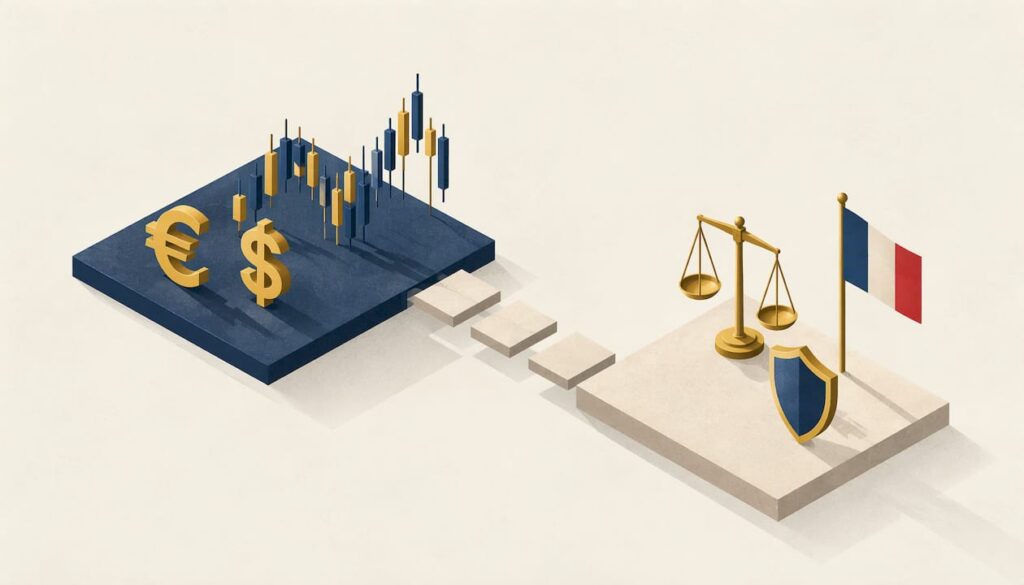
Forex trading is legal in France, but it is tightly regulated and officially described as high risk. A broker serving French residents needs the right authorisation, leverage for retail clients is capped, and advertising of these products to the public has been restricted since 2016. If you are looking at forex in France, the useful question is not “which platform is popular?” but “is this firm authorised for French clients, and can I afford to lose what I put in?” This guide covers both, in that order. It is for readers aged 18 or over.
Disclosure: EuroGain Online earns money from referral links and clearly labelled sponsored placements. These never decide our rankings or conclusions. Details are on our affiliate disclosure page.
TL;DR
- Retail forex and CFD trading is allowed in France, but binary options are banned for retail clients and the advertising of forex, CFDs and binary options to the public is restricted.
- Retail leverage is capped at 30:1 on major currency pairs, 5:1 on equity CFDs and 2:1 on crypto-asset CFDs.
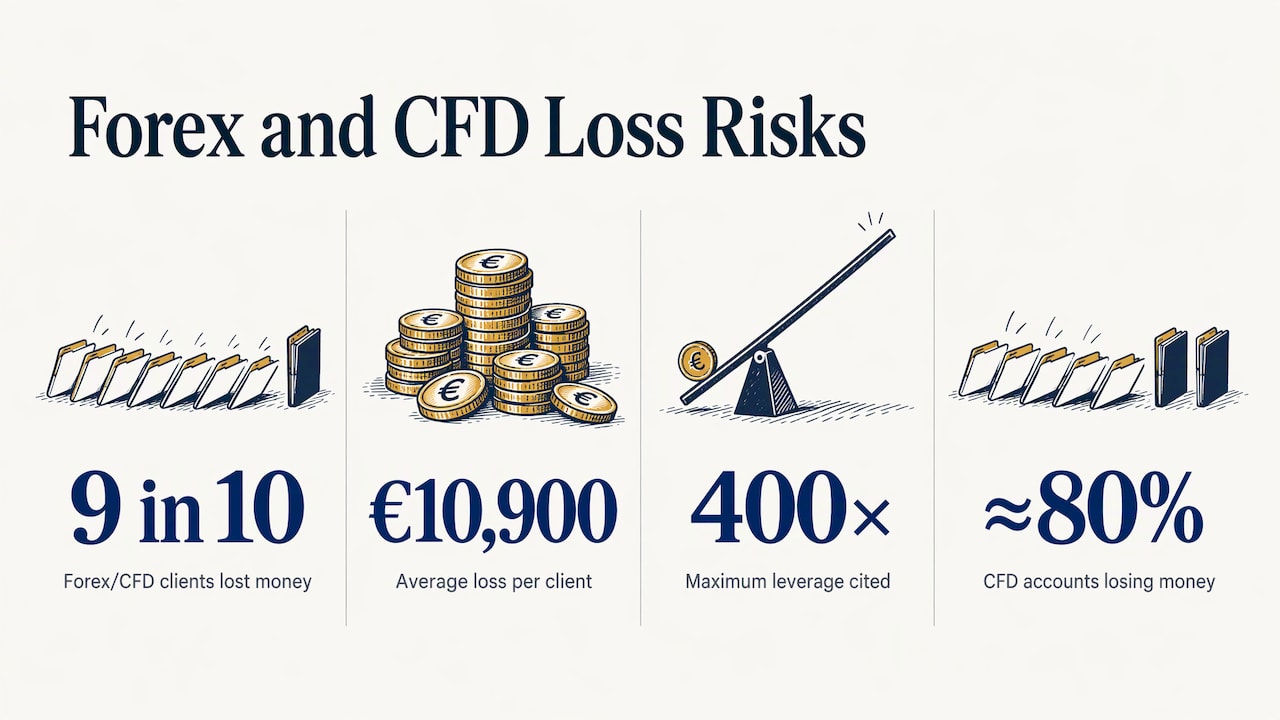
- The French regulator’s study found that 9 in 10 clients lost money on forex and CFDs, with an average loss of €10,900 per client.
- Check any firm on the Regafi register and the AMF blacklist, and check its registered head-office address, before you deposit.
- Authorisation in one country does not automatically cover another, so a broker’s licence has to match where you live.
Table of Contents
- What forex is and how it works from France
- Is forex trading legal in France?
- The risks, in the regulator’s own numbers
- How to check a forex broker in France
- Starting carefully: a beginner’s routine
- Where EuroGain fits
- Perspective
- FAQ
- Sources
What forex is and how it works from France
Forex (foreign exchange) is the market where currencies are exchanged against each other. Unlike a stock exchange, it has no single central venue: France’s savings-information platform ABE Infoservice explains that the market runs around the clock and is not regulated like a stock exchange, with prices set directly by professional participants such as banks.
When a retail client “trades forex”, they usually do not buy currency to hold. They open a leveraged position on whether one currency, such as the euro, will rise or fall against another, such as the dollar. Most retail forex is offered as a contract for difference (CFD), a derivative that pays the difference in price between opening and closing. Our guide to CFD trading versus forex explains how the two overlap.
Three terms matter from the start:
- Spread: the gap between the buying and selling price. It is the main cost on most trades.
- Leverage: a small deposit (margin) controls a much larger position. It multiplies gains and losses equally.
- Swap or rollover: a charge or credit for holding a position overnight.
Is forex trading legal in France?
Yes, with conditions. France regulates the area through the AMF (Autorité des marchés financiers, the markets regulator) and the ACPR (the prudential supervisor that keeps the register of authorised firms). The main rules for retail clients are these.
| Rule | What it says | Source |
|---|---|---|
| Binary options | Marketing, distribution or sale to retail clients is banned in France or from France | AMF decision of 2 July 2019 |
| CFD leverage limits | 30:1 on major currency pairs, 5:1 on equity CFDs, 2:1 on crypto-asset CFDs | AMF high-risk trading page |
| Advertising | Direct or indirect electronic advertising of forex, binary options and CFDs to the public is banned in French law since 2016 | DGCCRF |
The AMF’s national measures followed European ones. Its 2019 announcement made permanent the binary options ban in force since 2 July 2018 and the CFD restrictions in force since 1 August 2018.
The advertising rule has a practical consequence. The DGCCRF, the consumer and fraud-control authority, explains that these products are meant to stay with professionals who understand the risks, not be pushed at the general public. If a French-language ad promises easy, regular gains from forex or copy trading, treat it as a warning sign rather than an invitation.
What this means if you are a UK reader
The UK is outside the EU, and each country authorises firms separately. A firm that is authorised in one jurisdiction is not automatically allowed to serve clients in another. If you live in France, the French and EU framework applies to you. If you live in Britain and are only curious about the French market, the French rules describe what French residents can access, not what applies to you. Either way, the licence has to match where you live. For a comparable country guide, see our piece on forex in Spain and CNMV rules.
The risks, in the regulator’s own numbers
The AMF’s investor-protection page reports that in its 2014 study, 9 out of 10 clients who traded forex and CFDs lost money, with an average loss of €10,900 per client. The same page warns that leverage can multiply losses by up to 400 times. ABE Infoservice adds that CFD providers must publish the share of client accounts that lose money, generally close to 80%.
Those are the facts a reader should hold before anything else. Forex is not a reliable income source, and no strategy removes the risk of loss. Never trade money you need for rent, bills or savings, and never add funds to win back a loss.
How leverage turns small moves into large losses
ESMA, the EU securities regulator, gives a simple example in its retail investor guide to forex. With a €100 deposit at leverage of 200, you control a €2,000 position. If the instrument falls 10%, you owe the full €2,000 exposure’s loss, which is far more than your deposit. The guide adds that you can lose some, all or more than your initial deposit, and that fees and financing charges come on top.
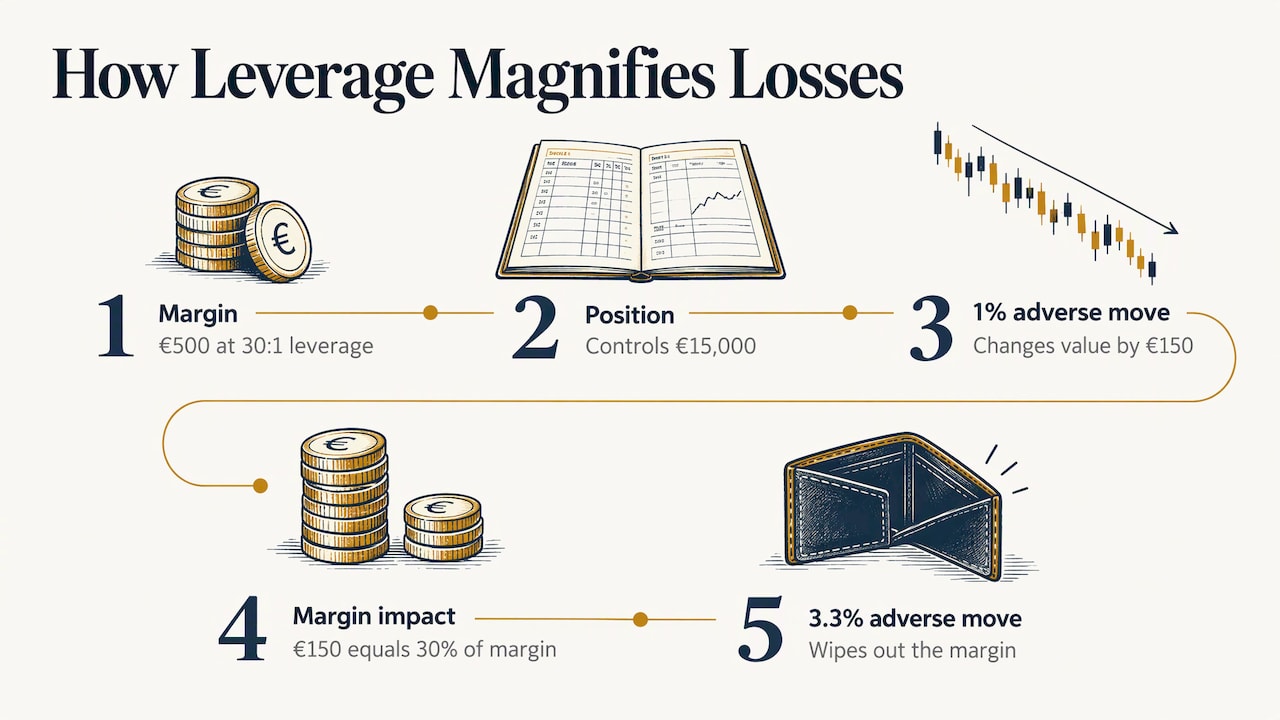
A worked version with the current French cap for major pairs: at 30:1, a €500 margin controls a €15,000 position. A 1% move against you changes the position’s value by €150, which is 30% of your margin. A 3.3% move would wipe out the margin entirely. Real brokers also close positions automatically when margin runs low, so the loss can arrive faster than you expect.
Costs beginners overlook
- Spreads widen around news releases and at quiet hours.
- Overnight swap charges apply to positions held past the daily cut-off and reflect the interest-rate difference between the two currencies.
- Deposit and withdrawal fees, and conversion costs if your account is in a different currency from your bank.
- Inactivity or account fees, which differ by firm and are in the client terms.
The broker’s own terms and fee schedule are the authority on each of these. Read them before you fund an account, not after.
How to check a forex broker in France
This is the step that matters most. The AMF says a firm offering investment services must be registered as an investment services provider and listed on the Regafi register. Work through this order:
- Find the legal entity. Brands are not regulated, companies are. Locate the full company name in the footer or client agreement.
- Search Regafi. Look up that exact entity. The DGCCRF advises checking the AMF blacklist and the ACPR’s Regafi register before you invest.
- Check the registered address. The AMF notes that a French office alone is not enough: the registered address decides whether the firm is treated as French or foreign.
- Identify the regulator that actually authorised it. ESMA stresses that it does not authorise brokers; national authorities do, so check with the national regulator named by the firm.
- Read the client agreement. Look at leverage, margin-call and close-out rules, fees, and whether negative balance protection applies.
- Test the service with a small step. Open a demo account first. Our guide to the forex demo account explains what to try on it.
Authorisation does not make trading safe. The AMF is explicit that it does not make the products risk-free. It only means the firm is supervised.
If you want to speak to a person, La finance pour tous lists the AMF’s Épargne Info Service line, 01 53 45 62 00, for questions about intermediaries.
Warning signs to walk away from
- Promises of guaranteed or regular profits.
- Pressure to deposit quickly or to “top up” after losses.
- A firm that cannot be found on Regafi or names no clear legal entity.
- Software that trades for you and takes control of transactions, or requests for card details that could be debited without your consent. ESMA warns about both.
- Paid courses promising you will become a trader in days. ABE Infoservice notes that real expertise takes years.
Starting carefully: a beginner’s routine
Nothing here is a way to profit. It is a way to limit the damage while you learn.
- Practise on a demo account until you understand margin, spreads and order types.
- Decide your maximum loss before you start, as a sum you can genuinely afford to lose. Keep it separate from living costs.
- Use low leverage. The legal maximum is a ceiling, not a target.
- Use stop-loss orders, which close a trade at a set level, and size each trade small relative to the account.
- Stick to a few liquid major pairs, where spreads are usually narrower than on exotic pairs.
- Keep a trade log and review it weekly, so you see your actual results rather than your memory of them.
Minimum deposits vary from broker to broker, and the amount is rarely the real cost. See broker minimum deposits for what to look at beyond the headline figure.
Copy trading and automation
Copy trading and automated systems are marketed to beginners as shortcuts. ABE Infoservice cautions that the copied trader may be paid on your activity and therefore be incentivised to take bigger risks. The DGCCRF describes schemes that promise easy, regular gains to non-expert audiences while nearly all participants lose their capital. If you still want to understand them, our pages on what to check with copy trading providers and automated forex trading cover costs, risks and account rules.
Where EuroGain fits
EuroGain Online publishes independent reviews and comparisons of forex brokers and casinos, with rankings that are not set by paid placement and a clear statement of how featured listings are funded. Our broker reviews and forex broker review checklist are built around the points in this guide: the legal entity, the regulator, deposits and withdrawals, spreads and customer support. You can set shortlisted firms side by side on our compare brokers page.
Sponsored placements are labelled as such and kept apart from editorial reviews. Always confirm a firm’s authorisation for your own country of residence on the official register, whatever any review says, including ours.
Perspective
Most people who search for forex in France are really asking one thing: can I trust this firm with my money? We think the honest answer starts with the regulator, not with the broker’s own marketing. A licence is the entry ticket, and it still has to match the country you live in.
That is why our reviews start with the legal entity, the regulator and the client terms, and then look at what you will actually meet: how deposits and withdrawals work, what spreads look like, and how support responds. We are funded by referral links and labelled sponsored placements, and we keep those separate from our editorial conclusions. A reader should be able to see exactly how that works, which is why we publish it.
We also say plainly what the regulators say. Most retail clients lose money on forex and CFDs, leverage magnifies losses, and nobody should treat trading as income. Good information does not change those odds. It does help you avoid the avoidable mistakes: an unregistered firm, a hidden fee, a leverage setting you did not understand.
Evan Alexander
FAQ
Can I trade forex in France as a retail client?
Yes. Retail forex and CFD trading is permitted, but under restrictions: leverage caps, a ban on binary options for retail clients, and limits on advertising. The provider should be authorised and listed on the Regafi register. You should be 18 or over and able to bear a total loss of what you deposit.
What is the maximum leverage for forex in France?
The AMF states retail CFD leverage limits of 30:1 on major currency pairs, 5:1 on equity CFDs and 2:1 on crypto-asset CFDs. Other limits apply to other asset types. Your broker’s terms show the exact limit on each instrument.
How do I check whether a broker is authorised?
Find the firm’s full legal name, then search for it on Regafi and check it against the AMF blacklist. Compare the registered head-office address with what the website claims. For a firm authorised abroad, confirm with the regulator in that country, because ESMA does not authorise brokers itself.
Can I make a living from forex?
The official evidence points the other way. The AMF’s study found that 9 in 10 clients lost money, and ABE Infoservice notes that short-term currency moves are very hard to predict. Treat any forex activity as high-risk speculation with money you can afford to lose, not as income. If trading is causing you stress or debt, stop and speak to your bank or a free debt-advice service.
Sources
- AMF: Forex, binary options and high-risk trading
- AMF: decision of 2 July 2019 on binary options
- AMF: national measures on binary options and CFDs, 2019
- AMF: investing with a foreign broker
- DGCCRF: online trading investment warnings
- ABE Infoservice: online trading
- ESMA: Trading in foreign exchange (forex)
- La finance pour tous: Le Forex
Recommended
- How to Choose a Forex Broker: A Step-by-Step Guide
- Forex Broker Reviews: What to Check First
- Forex Trading Tax: Rules Across Europe Explained
- Compare Forex Brokers: Fees, Regulation & Costs
Editorial Disclaimer: This article is provided for general informational and educational purposes only and does not constitute financial, investment, legal, or gambling advice. Where relevant, gambling is intended only for adults aged 18 or over, or the higher legal age in their jurisdiction, and involves a risk of financial loss. Forex and CFD trading involve a high risk of loss, particularly when leverage is used. Regulations, product availability, fees, and promotional terms may vary by juris