
Most forex account types differ in just four things: the size of trade you can place, how you pay (spread, commission or both), how overnight financing is handled, and who makes the trading decisions. Leverage is set mostly by your regulator and client category, not by the account label. This guide sets out each type, what it costs you in practice, and how leverage and margin decide how fast a loss can grow.
This is educational content for adults. Forex and CFD trading carries a high risk of loss, and nothing here is a recommendation or a promise of profit. We earn affiliate commissions from some brokers we cover, which never decides our rankings; see our affiliate disclosure.
TL;DR
- Size accounts (standard, mini, micro, cent) change the lot size you trade and the deposit you need. They do not change the market.
- Pricing accounts (standard, raw spread, ECN, STP) change how you pay: a wider spread with no commission, or a tight spread plus a commission.
- Islamic (swap-free) and managed accounts change financing and control. A swap-free label alone does not prove an account is Sharia-compliant, and a managed account hands trading decisions to someone else for a fee.
- Leverage magnifies gains and losses equally. For UK retail clients the FCA limits CFD leverage to between 30:1 and 2:1, depending on the asset.
- Always check the legal entity, regulator and client category on the account you are opening. Authorisation in one country does not apply across Europe.
Table of Contents
- The main forex account types at a glance
- Account size: standard, mini, micro and cent
- Pricing models: standard, raw spread, ECN and STP
- Islamic (swap-free) accounts
- Managed accounts
- Demo accounts
- How account leverage works
- Leverage limits by market
- How to choose an account type
- Where to find broker comparisons
- Our perspective
- FAQ
- Sources
The main forex account types at a glance
Brokers use different names, so the same account can be called “Classic”, “Standard” or “Prime” depending on the firm. What matters is which of the following categories it falls into. Many accounts combine two: for example, a standard-size account with raw pricing, or a micro account that is also swap-free.
| Type | What it changes | Typical suitability | Main watch-point |
|---|---|---|---|
| Demo | Virtual money, live-style prices | Learning a platform | Fills and emotions differ with real money |
| Cent / micro | Very small lot sizes, small deposit | First live trades with small risk | Displayed balance can mislead |
| Mini | Mid-sized lots | Newer traders with modest funds | Costs per trade still add up |
| Standard | Full-size lots, spread-based pricing | Traders with more capital | Larger lots mean larger swings |
| Raw spread / ECN | Tight spread plus commission | Frequent, short-term traders | Commission must be included in total cost |
| STP | Orders passed on, floating spread | Those who prefer no commission | Spread includes a mark-up |
| Islamic (swap-free) | No overnight swap interest | Traders who avoid interest | May carry a fee instead |
| Managed | A manager trades for you | Those unwilling or unable to trade | Fees and discretionary control |
Account size: standard, mini, micro and cent
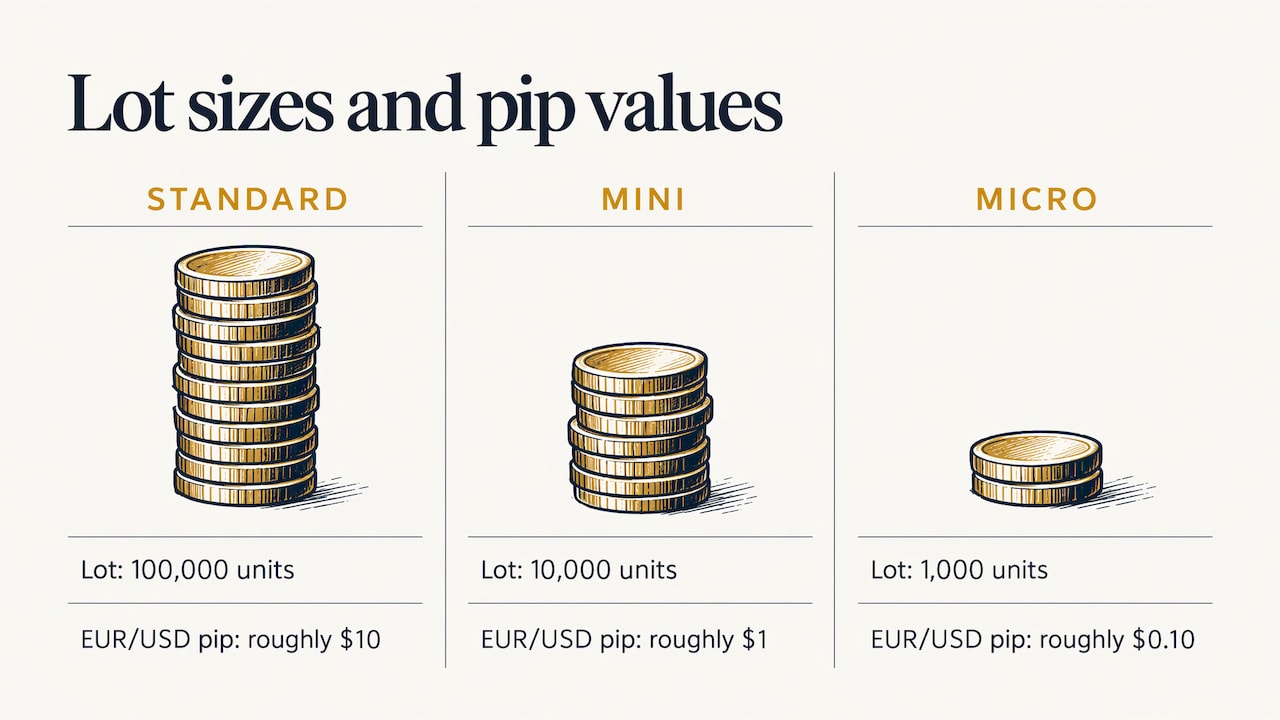
A standard lot is 100,000 units of the base currency, a mini lot is 10,000 and a micro lot is 1,000. Investopedia’s overview of account types describes the standard account as the full-size option, with mini accounts capping lots at a tenth of that for beginners or those with limited funds.
The practical effect is on risk per pip. On a EUR/USD trade, one pip is roughly $10 on a standard lot, $1 on a mini lot and $0.10 on a micro lot. Smaller lots let you size a position so that a stop-loss, the order that closes a trade at a set loss, risks an amount you can afford.
Cent accounts need a careful read
Cent accounts display your balance in cents, so a $10 deposit can show as 1,000 cents. That bigger-looking number is not extra capital. Before trading, check the contract size, minimum order size and pip value in the broker’s terms, and work out what a single pip costs you in pounds, dollars or euros.
How much do you actually need?
Many brokers allow accounts to open with very small deposits, but opening an account and trading it sensibly are different things. A common position-sizing formula is: position size in lots = amount you are willing to risk, divided by (stop distance in pips multiplied by pip value per lot). Run that calculation with a realistic stop and you will often find that a tiny deposit forces either a very small position or an uncomfortably large risk share. Our guide to broker minimum deposits covers what to look for in the terms.
Pricing models: standard, raw spread, ECN and STP
This is where account types affect your costs most directly. The spread is the gap between the buy and sell price. Every trade starts with you paying that gap, and some accounts add a commission on top.
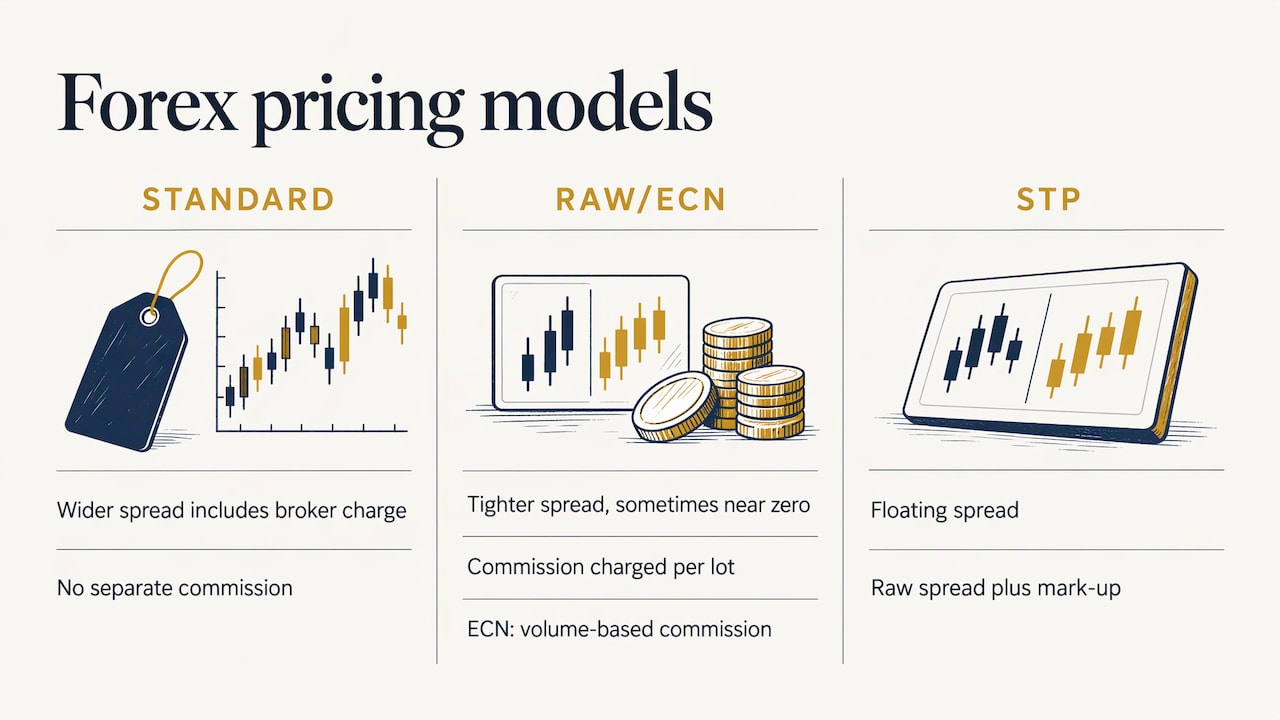
Standard (spread-only) accounts build the broker’s charge into a wider spread, with no separate commission. They are simple to compare: the price you see is the price you pay.
Raw spread and ECN accounts show a tighter spread, sometimes close to zero, and charge a commission per lot. FXEmpire’s explanation of forex pricing describes ECN brokers as charging raw spreads plus a volume-based commission, while STP brokers charge floating spreads that combine the raw spread with a mark-up.
A worked cost comparison
The figures below are illustrative, not quotes from any broker. Suppose you trade one standard lot of EUR/USD, where one pip is about $10.
- Spread-only account: spread of 1.0 pip, no commission. Cost: about $10.
- Raw account: spread of 0.1 pip plus a commission of $3.50 per side, so $7 round trip. Cost: about $1 + $7 = $8.
The raw account is cheaper in this example, but only because the numbers favour it. If the raw spread widens during news, or the commission is higher, the gap closes. The only fair test is total cost per round trip at the times you actually trade. We go deeper on this in spreads vs commission, and you can compare real terms in our guides to raw spread brokers and raw spreads. UK readers should also see raw spread brokers in the UK.
Some firms advertise zero commission. That is simply the spread-only model described above, so read what “free commission” brokers really charge before assuming it is cheaper.
What to compare in any pricing model
- Average spread on the pair you trade, at your usual hours, not the “from” figure.
- Commission per lot, per side, in your account currency.
- Overnight financing (swap) if you hold positions past the daily rollover.
- Minimum order size and how orders are filled during fast markets.
- Fees for deposits, withdrawals and inactivity.
Islamic (swap-free) accounts
A standard account charges or pays overnight swap interest on positions held past the daily cut-off. An Islamic account removes that interest for traders who avoid it on religious grounds. Our explainer on forex swap rates shows how those overnight charges are calculated.
Two points matter here. First, the terms are set by each broker. Swap-free accounts commonly have the same trading conditions as standard accounts, but the exemption may apply only to certain instruments, the list of tradable instruments can be shorter, and a fixed fee or commission may stand in for the swap. Brokers can also withdraw swap-free status for abuse, such as holding trades purely to exploit the exemption, or for long inactivity.
Second, “swap-free” is a pricing description, not a religious ruling. If Sharia compliance matters to you, read the account agreement closely and ask a qualified scholar rather than relying on a label. Our page on swap-free forex brokers sets out what is and is not known.
A sensible test is to model the trade you intend to make: cost over one session, three sessions and several weeks, including the spread at your trading time and any administration charge. That tells you more than the label does.
Managed accounts
In a managed account, a professional manager trades your money on your behalf. Investopedia’s entry on managed forex accounts notes that the manager typically has discretionary power and can trade without consulting you, and that fees are usually a share of profits. It cites performance fees of 20% to 30% for top managers.
That structure makes a few checks essential before you commit:
- Is the manager authorised, and by which regulator, for this activity in your country?
- What exactly is the fee: performance, management, or both, and is there a high-water mark?
- Who holds your money, and can you withdraw at any time?
- What is the maximum drawdown the manager is allowed to run?
The US regulator’s investor bulletin on forex also notes that authorities have brought fraud actions against forex investment programmes, so verify authorisation on the official register, not on the manager’s website. Our guides on forex managed accounts and copy trading providers list what to check.
Demo accounts
A demo account uses virtual money and live-style quotes. It is the right place to learn a platform’s order types, margin display and stop-loss behaviour without risking cash. Treat results with caution: no money is at stake, and fills and your own decision-making under pressure will differ on a live account. Many brokers offer demo accounts for free or for a limited period, so check the terms.
How account leverage works
Leverage lets you control a position larger than your deposit. The deposit you put up to open it is called margin, a good-faith deposit held against the trade, not a fee. At 30:1 leverage, a $30,000 position needs $1,000 of margin.
It works in both directions. Investopedia’s explainer says that when account equity falls below the required margin level, a margin call occurs, and if the shortfall is not fixed the broker may close positions, locking in the loss even if the market later reverses.
A worked example at 30:1
You open a £30,000 position with £1,000 margin at 30:1. A 1% move against you is a £300 loss, 30% of your margin. A 3.3% move against you would wipe out the entire £1,000. The position is usually closed before that: under the EU and UK retail framework, brokers must close positions automatically once margin falls to 50% of the requirement, as TheIndustrySpread’s summary notes, though how that is applied is set out in each broker’s terms.
The same position at 500:1 would need only £60 of margin. The market has not become riskier, but a 0.2% move would now consume the whole deposit. This is why high leverage is not the same as high opportunity. Our forex margin guide covers margin levels and close-outs in more depth.
Why you can lose more than you expect
The SEC’s investor bulletin warns that with leverage even a small adverse move can wipe out an entire investment, and that depending on the dealer agreement a trader may owe more than the initial deposit. Transaction costs can also turn small winning trades into losing ones. In the UK and EU, retail clients have negative balance protection, which stops losses going beyond the account balance, but it only applies to clients classed as retail.
Leverage limits by market
Leverage is largely a regulatory matter, so the same account type can carry very different limits depending on where you are and how you are classified. The figures below are as published in the sources linked, and the rules can change, so check the regulator’s current page.
| Region | Retail leverage rule | Source |
|---|---|---|
| UK (FCA) | 30:1 down to 2:1 depending on the underlying asset | FCA PS19/18 |
| EU (ESMA regime, 2018) | 30:1 majors, 20:1 minors and gold, 10:1 commodities, 5:1 equities, 2:1 crypto | TheIndustrySpread, June 2026 |
| US (CFTC/NFA) | 50:1 and 20:1 | TheIndustrySpread, June 2026 |
| Japan (JFSA) | 25:1 | TheIndustrySpread, June 2026 |
| Australia (ASIC) | Cut from 500:1 by an order effective 29 March 2021 | TheIndustrySpread, June 2026 |
The same report notes that Cyprus’s regulator reduced leverage on non-major CFDs to 10:1 through a directive of 5 September 2025, while keeping 30:1 for majors. Authorisation in one country does not apply throughout Europe, so confirm which entity opens your account and which regulator supervises it.
Professional status and offshore accounts
Some brokers offer much higher leverage to clients who qualify as professional, or through entities regulated outside the UK and EU. Moving from retail to professional status can mean giving up protections such as negative balance protection, so treat any offer of far higher leverage as a trade-off, not a perk. TheIndustrySpread’s analysis also describes reclassifying clients to offer higher leverage as an enforcement risk for firms. Our guide to professional forex brokers explains who qualifies and what changes.
How to choose an account type
Work through these questions in order.
- Check the entity and regulator. Find the legal name on the account agreement and confirm it on the regulator’s official register. Note which client category you will be placed in.
- Decide your trade size. Use the position-sizing formula above. If you cannot size a trade to risk an amount you could comfortably lose, the account or deposit is wrong for now.
- Estimate your real cost. Multiply your typical number of trades by the round-trip cost for your pair, including commission and swap.
- Read the financing terms. Overnight holders need the swap table. Swap-free users need the fee and instrument list.
- Read the withdrawal terms. Check fees, minimums and processing times before depositing.
- Start on a demo, then fund a live account with money you can afford to lose.
To compare brokers on these points, use our broker comparison and the checklist for forex broker reviews.
Where to find broker comparisons
EuroGain Online publishes independent reviews and comparisons of forex brokers and online casinos, with rankings that paid placements do not influence. Where a listing is sponsored, it is labelled as such and kept separate from editorial reviews. You can browse our broker reviews or start from the EuroGain Online homepage to see how account terms, regulation and costs are laid out side by side.
Our reviews present what regulators’ registers, broker terms and official documents state. Where we describe an account’s terms, that is the broker’s own published claim, and our assessment is labelled as editorial opinion.
Our perspective
Account types are often sold as a ladder, from beginner to pro, with leverage as the reward for climbing. We see it differently. The label matters less than three plain facts: who the regulated entity is, what one round trip really costs you, and how much a bad day can take from your balance.
That is why we compare accounts on published terms and official registers, and why we keep editorial rankings separate from sponsored placements. Cheaper pricing and higher leverage are not the same as a better account. A trader who sizes positions carefully on a standard-leverage account is better placed than one who has the maximum on offer and no plan for a margin call.
Our aim is to give you the information to choose an account on evidence, and to make clear when something is a broker’s claim rather than something we have verified. Trading is not a dependable income source, and no account type changes that.
Evan Alexander
FAQ
Which forex account type is best for beginners?
There is no single best account, but beginners usually start with a demo account and then a small-lot account such as a micro or mini account. Small lot sizes let you limit the amount at risk per trade. Whatever you choose, confirm the broker’s regulator and your client category first.
What is the difference between a standard and a raw spread account?
A standard account charges through a wider spread with no commission. A raw spread account shows a much tighter spread but adds a commission per lot. Which is cheaper depends on your trade size, pair and trading hours, so compare the total round-trip cost.
What leverage can UK retail clients use?
The FCA limits CFD leverage for retail clients to between 30:1 and 2:1, depending on how volatile the underlying asset is. Higher leverage is generally tied to professional client status, which can remove some retail protections. Check the broker’s current terms and the FCA’s published rules.
Does higher account leverage mean higher profits?
No. Leverage magnifies the size of both gains and losses on the same price move. It also shrinks the move needed to trigger a margin call or automatic close-out. Many traders find that lower leverage with disciplined position sizing is easier to manage.
Is a swap-free account the same as an Islamic account?
Not necessarily. Swap-free describes the removal of overnight interest. Whether an account meets Islamic finance principles is a religious question, and a broker’s label does not settle it. Read the account agreement, including any replacement fees, and take advice from a qualified scholar if it matters to you.
Forex and CFD trading is high risk and unsuitable for many people. Only trade with money you can afford to lose. If trading is affecting your wellbeing, free support is available from your doctor or a local debt and mental health service.
Sources
- Investopedia: Forex Basics, Setting Up an Account
- Investopedia: Managed Forex Accounts
- Investopedia: How Leverage Works in the Forex Market
- FXEmpire: Forex Pricing Explained
- FCA: PS19/18 Restricting contract for difference products sold to retail clients
- US SEC: Foreign Currency Exchange (Forex) Trading for Individual Investors
- TheIndustrySpread: Why 2026 retail FX rules move beyond the 30:1 leverage cap
- TheIndustrySpread: Retail FX leverage caps hold at 30:1
Recommended
- Raw Spread Brokers UK: Costs and Account Access
- Raw Spreads: Compare ECN Forex Broker Costs
- Raw Spread Brokers: Compare Costs and Account Terms
- Swap-Free Forex Brokers for Saudi Traders: What’s Known
Editorial Disclaimer: This article is provided for general informational and educational purposes only and does not constitute financial, investment, legal, or gambling advice. Where relevant, gambling is intended only for adults aged 18 or over, or the higher legal age in their jurisdiction, and involves a risk of financial loss. Forex and CFD trading involve a high risk of loss, particularly when leverage is used. Regulations, product availability, fees, and promotional terms may vary by juris