
Copy trading lets you link part of your money to another person’s trading, so that their trades are replicated in your account in proportion to the amount you allocate. It is not a shortcut to profit. You inherit the lead trader’s losses as well as their gains, and many of the products involved, such as leveraged CFDs, carry a high risk of loss. This guide explains the mechanics, the costs, the UK rules and a practical way to assess a lead trader. It is written for adults (18+) and is general information, not personal advice.
TL;DR
- Copy trading automatically replicates a chosen trader’s positions in your account, scaled to the amount you allocate. You pick the trader, the allocation and when to stop.
- Results are never guaranteed. Spreads, fees and execution timing mean your outcome can differ from the trader’s, and leveraged products can produce losses.
- In the UK, the FCA treats fully automatic copying as portfolio management, which requires authorisation. Check the firm on the FCA Register, because authorisation in one country does not carry over to another.
- Judge a lead trader on risk, history and consistency rather than on a single strong month, and use any stop-loss or drawdown tools the platform provides.
- Only use money you can afford to lose. Gambling-style behaviour, such as adding funds to recover losses, is the wrong way to use it.
Table of Contents
- What copy trading is and how it works
- Copy trading, mirror trading and portfolio management
- What you control, and what you do not
- Is copy trading profitable?
- Is copy trading legal in the UK?
- How to assess a lead trader
- Costs to look for before you start
- Perspective
- Where to compare regulated providers
- A short pre-flight checklist
- FAQ
- Sources
What copy trading is and how it works
The international securities regulators’ body IOSCO describes copy trading, mirror trading and social trading as online imitative trading practices, where retail investors automatically replicate the trades of lead traders. The people being copied are also called signal providers or, in the search terms many readers use, a copy trader.
In practice it works like this:
- You open an account with a platform or broker that offers copying.
- You browse lead traders and their published statistics.
- You allocate a sum, or a proportion of your funds, to one trader.
- When the trader opens or closes a position, the platform opens or closes a proportionally sized position in your account.
The key word is proportional. If a lead trader commits 10% of their account to a trade, the software commits roughly 10% of your allocated amount to the same trade. Some systems let you choose whether to copy positions that are already open or only those the trader opens after you start, as one major platform’s explanation shows. Whether that option exists depends on the provider, so read the terms before you commit.
The FCA describes the result as “people-based portfolios”: you allocate money according to who you trust rather than according to your own analysis of markets. That is the appeal for beginners, and it is also the main weakness. You are making one decision, which person to follow, and everything else follows from it.
Copy trading, mirror trading and portfolio management
The three labels overlap, and platforms use them loosely. What matters is how much input you give on each trade.
| Feature | Fully automatic copying | Copying with your approval on each trade |
|---|---|---|
| Who acts on each trade | The software, with no action from you | You, before each transaction |
| UK regulatory treatment | Portfolio management, needing FCA authorisation | Not portfolio management, though other investment services may apply |
| Your effort | Low once set up | Higher, and you can decline trades |
| Main risk | Inheriting every decision the lead trader makes | Delays and your own second-guessing |
The regulatory column comes from the FCA’s copy trading page, which says automatic copying with no client intervention is portfolio management, while a model where the client must act before each transaction is not, although other investment services may still be involved.
What you control, and what you do not
On most platforms you keep several levers:
- Which trader to copy. This is your biggest decision.
- How much to allocate. Platforms set different minimums, and the ratio between the copied and copying accounts also varies, according to the FCA. There is no single figure for how much you need, so check the minimum on the platform’s own fee and terms page.
- When to stop. You can generally stop copying or adjust the allocation. Some platforms offer a stop-loss on the copy relationship that closes it when its value falls below a percentage you choose, and some offer maximum drawdown limits. These tools are platform-specific, so confirm they exist and how they work before relying on them.
What you do not control is the lead trader’s choice of instruments, leverage or timing. If they hold a losing position for weeks, so do you, unless you step in.
Is copy trading profitable?
There is no honest yes or no. IOSCO’s report says profitability is not guaranteed and that copy trading does not remove market risk. It also notes that imitative trading is mostly associated with short-term, potentially higher-risk strategies, often in complex or volatile products such as forex and crypto-assets, which can expose investors to losses from leveraged products.
A few reasons your results can differ from the trader you copy:
- Execution timing. Your trade is placed after theirs, sometimes at a slightly different price.
- Spreads and fees. The cost of entering and leaving each position comes out of your account, and a trader who trades very often generates more of it.
- Account size. Smaller allocations can be affected by minimum position sizes and rounding.
- Overnight and financing charges on leveraged positions held open.
Lead traders can also be paid in ways that shape their behaviour. Some earn a flat monthly subscription from followers, while others earn spread rebates on their own trades, so check how a platform rewards the people you might follow and whether that creates an incentive to trade more than is sensible.
Behavioural research raises another point. An Oxford Saïd Business School academic quoted by Which? says retail investors tend to sell winners too early and hold losers too long, which can raise tax liability and costs when their trades are copied. Many lead traders are ordinary retail investors, not professionals.
A writer for Finder, who holds a DipFA qualification, makes a fair summary: there is no free lunch, because a lead trader’s failures pass directly to the follower.
Leverage and CFDs
Many copied portfolios hold CFDs, which are leveraged. Leverage magnifies gains and losses alike, and a fast move against a position can lose more than you expected relative to your stake. If you are new to the products, our guide to CFD trading versus forex explains the difference. The practical rule: never allocate money you need for rent, bills or emergencies, and never add funds to win back a loss.
Another UK point from Which?: copy trading often involves assets such as crypto and CFDs, which may not be held in tax-advantaged accounts like an ISA. Tax treatment depends on your circumstances, so check HMRC guidance or speak to a qualified tax adviser.
Is copy trading legal in the UK?
Yes, but who offers it and how matters. The FCA classifies copy trading as portfolio or investment management where the account holder gives no active manual input, and that triggers authorisation and conduct obligations for the firm. A provider serving UK clients therefore needs the right permissions.
What to do with that:
- Identify the legal entity that holds your account. Large groups often operate several entities in different countries, and the one serving you may not be the one named in the advertising.
- Look the entity up on the FCA Register and confirm that its permissions fit what it offers.
- Do not assume that authorisation in one country covers another. ESMA says copy trading should be assessed case by case, and where it amounts to portfolio management or investment advice, MiFID II requirements such as suitability assessments apply. That is EU law, and it is not the UK regime.
- Be careful with offshore providers. The Dutch regulator, the AFM, warns that many copy trading providers are based abroad and may operate outside local supervision, so investors can lose protections, including any assessment of the lead trader’s competence.
Our checklist, what to check in forex brokers and copy trading providers, walks through entity, regulator and client-money questions in more detail.
How to assess a lead trader
IOSCO says firms should consider lead traders’ qualifications, knowledge, competence and complaints history, and keep reviewing their conduct and the outcomes copiers get. You can borrow that logic as an individual. IOSCO also warns that lead traders are often portrayed as experts, and that this perceived credibility can hide the real level of risk, particularly where performance is not independently verified.
A practical screen:
- Track record length. A trader who has only been through one kind of market has not been tested. Look for a history that includes a rough patch.
- Maximum drawdown. The largest peak-to-trough fall tells you more about what you might endure than the headline return does.
- Leverage and instruments. A high-return profile built on heavy leverage can fall as fast as it rose.
- Trading frequency. More trades mean more spread and fee cost for you.
- Concentration. One trader or one instrument is a single point of failure. Spreading a small allocation across more than one approach limits the damage from one bad run, although it does not remove market risk.
- Whether statistics are verified by the platform, and whether the figures include fees.
- Consistency of style. Sudden changes in risk-taking are a warning sign.
A worked example with invented numbers
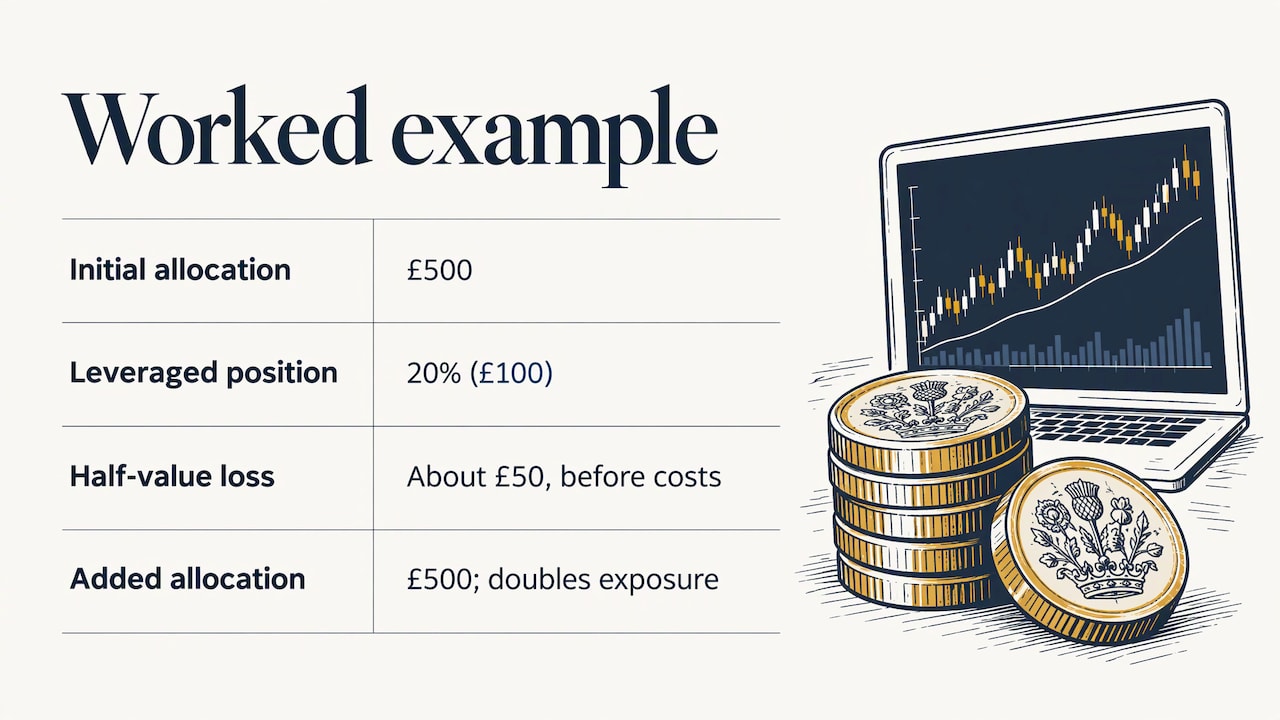
This is an illustration, not a real account. Suppose you allocate £500 to a lead trader who commits 20% of their account to a leveraged position. Roughly £100 of your allocation goes into that trade. If the position falls enough to lose half its value, you lose around £50 on that trade alone, and then spread and financing costs come on top. If you then add another £500 to “recover”, you have doubled your exposure to the same decision-maker. Setting a stop-loss or drawdown limit in advance, where the platform allows it, and treating the allocation as money you accept losing, is the safer habit.
Costs to look for before you start
Platforms differ, so check each item on the provider’s own terms and fee pages:
- Spreads on the instruments being copied, and any markup on them.
- Commission or performance fees, if charged.
- Financing charges on leveraged positions held overnight.
- Withdrawal fees, currency conversion and inactivity fees.
- Minimum allocation per trader and minimum account funding.
- Any subscription the lead trader charges.
For one provider’s account rules and cost structure, see our review of Axi copy trading risks, costs and account rules. If you are weighing automated approaches more broadly, automated forex trading covers the benefits and the costs.
Perspective
At EuroGain we read copy trading as a tool that moves the hardest question, who to trust, to the front. The mechanics are simple, which is exactly why the checking has to be done up front. Our reviews focus on the parts a reader can verify: the regulated entity, the cost schedule in the broker’s own terms, deposit and withdrawal conditions and the way the platform presents lead trader statistics.
Our editorial view is that a good copy trading provider makes it easy to see risk, not only return. That means drawdown figures beside performance figures, clear fee disclosure and visible regulatory status. We rank on those criteria, and we do not let commercial relationships decide a ranking or a conclusion. Where a placement is sponsored, we label it separately from our independent reviews.
We would rather a reader walk away understanding the downside and choose a small, well-understood allocation than chase a chart. That is the standard we try to hold ourselves to.
Evan Alexander
Where to compare regulated providers
If you want to compare brokers before choosing where to copy, EuroGain Online publishes independent reviews and comparisons of online casinos and forex brokers, covering regulation, costs and account terms. Our comparisons are editorial, and featured placements are labelled as such. Start with our broker comparison on fees, regulation and costs, or browse everything from the EuroGain Online homepage.
We earn referral fees when readers open accounts through some links, and that never decides rankings or conclusions. Trading CFDs involves a high risk of losing money, so only use funds you can afford to lose.
A short pre-flight checklist
Before allocating any money:
- Confirm the legal entity and its FCA authorisation on the FCA Register.
- Read the risk warning and the percentage of retail accounts that lose money, which regulated CFD providers must publish.
- Check the minimum allocation, fees and spreads.
- Pick a stop-loss or drawdown level in advance.
- Decide the total you can afford to lose, and stick to it.
- Keep a record of why you chose the trader, and review it regularly.
If trading starts to affect your finances or wellbeing, stop and speak to a free debt adviser or a support service. Gambling-style patterns, such as chasing losses, are warning signs.
FAQ
Is copy trading actually profitable?
Not reliably. IOSCO says profitability depends on the trader and the market and is never guaranteed, and that copy trading does not remove market risk. Costs and execution timing can make your result differ from the trader’s, and leveraged CFDs carry a high risk of loss.
Is copy trading legal in the UK?
Yes, provided the firm is properly authorised. The FCA treats automatic copying with no client input as portfolio management, which needs FCA authorisation. Check the specific legal entity on the FCA Register before you deposit.
How much money do I need for copy trading?
It depends on the platform. Minimums for copying and the ratio between the copied and copying accounts vary, so the FCA does not give one figure. Read the provider’s terms for the minimum allocation per trader and the minimum funding, and start small.
Can I stop copying a trader?
Generally yes. You choose the trader and the allocation, and can adjust or stop the copy. Some platforms also offer stop-loss or drawdown settings that close the copy automatically, but confirm what your provider offers before relying on them.
Sources
- IOSCO, Online Imitative Trading Practices (FR/06/2025)
- FCA, Copy trading
- ESMA, Supervisory Briefing on Copy Trading
- AFM, Wat is copytrading?
- Which?, Will copying someone else’s investments make you better off?
- Finder, What is copy trading and how does it work?
- Wikipedia, Copy trading
Recommended
- Forex Brokers and Copy Trading Providers: What to Check
- Axi Copy Trading: Risks, Costs and Account Rules
- Raw Spread Brokers UK: Compare Costs and FCA Status
- Forex order types: a clear guide for UK traders
Written with BabyLoveGrowth’s AI
Editorial Disclaimer: This article is provided for general informational and educational purposes only and does not constitute financial, investment, legal, or gambling advice. Where relevant, gambling is intended only for adults aged 18 or over, or the higher legal age in their jurisdiction, and involves a risk of financial loss. Forex and CFD trading involve a high risk of loss, particularly when leverage is used. Regulations, product availability, fees, and promotional terms may vary by juris