

Most forex withdrawal problems come from one of four places: the broker’s own review, the payment route, a mismatch between the account and the payee, or a broker that never intended to pay. The first three are fixable with the right paperwork and a clear timeline. The fourth is a warning sign you can spot before you deposit. This guide shows how to tell which one you face, what to send and when, and how to choose a broker where the problem is less likely to arise. It is general education, not personal financial advice. CFDs and leveraged forex can lose money rapidly, and nothing here suggests trading is a reliable source of income.
TL;DR
- A withdrawal is finished only when the money is in your bank or payment account, not when the platform says “approved” or “sent”.
- Separate the broker’s review time from the payment’s travel time, and ask which of approval, dispatch or arrival any stated deadline refers to.
- Delays are usually caused by identity checks, open positions tying up margin, payment-route mismatches or bank intermediaries. Fix those first.
- Never pay a fee, tax or extra deposit to “release” your own money. That is a recognised fraud pattern.
- Check the legal entity and regulator before depositing, and keep a written timeline from day one.
Table of Contents
- What counts as a withdrawal problem
- How a normal withdrawal works
- Common causes of forex withdrawal delays
- Forex deposit delays
- What to do when a withdrawal is delayed
- Warning signs that point to something worse
- Choosing a broker to avoid the problem
- Our perspective
- Compare brokers before you deposit
- FAQ
- Sources
What counts as a withdrawal problem
Traders use the phrase for several different situations, and the fix depends on which one you are in.
- Slow but moving. The request is approved, the status says pending or processing, and the stated period has not yet passed.
- Stuck in review. The broker is asking for documents or has not responded to your upload.
- Rejected or failed. The payment provider or bank has declined the payout.
- Marked complete, nothing received. The platform says funds were sent, but your account shows nothing.
- Refused. The broker will not pay, or invents conditions that were never in its terms.
The first four are operational. The fifth is where regulation and, sometimes, fraud come in. A related issue, deposits that do not appear in the trading account, has similar causes and is covered further down.
How a normal withdrawal works
The sequence is similar everywhere, though names and timings differ by broker and route.
- You request a withdrawal from the client area. Only the free part of your balance can go, meaning money not tied up as margin in open positions.
- The broker’s payments or compliance team reviews it. Identity, source of funds and whether the destination matches the account holder are the usual checks.
- The broker releases the payment to a card processor, bank or e-wallet.
- The payment travels. Card refunds, domestic transfers and international wires each take their own time, and a wire can pass through intermediary banks.
- Your bank or wallet credits the money.
Published broker help pages show how much the stated timings vary by method: e-wallets are typically quicker than cards and bank transfers, and international wires are slowest. The exact figures belong to each broker’s own withdrawal page, which also states cut-off times and fees. Read them before you deposit, not after a delay. Our Exness withdrawals guide shows what that kind of page looks like when it is broken down into deposits, fees and processing times.
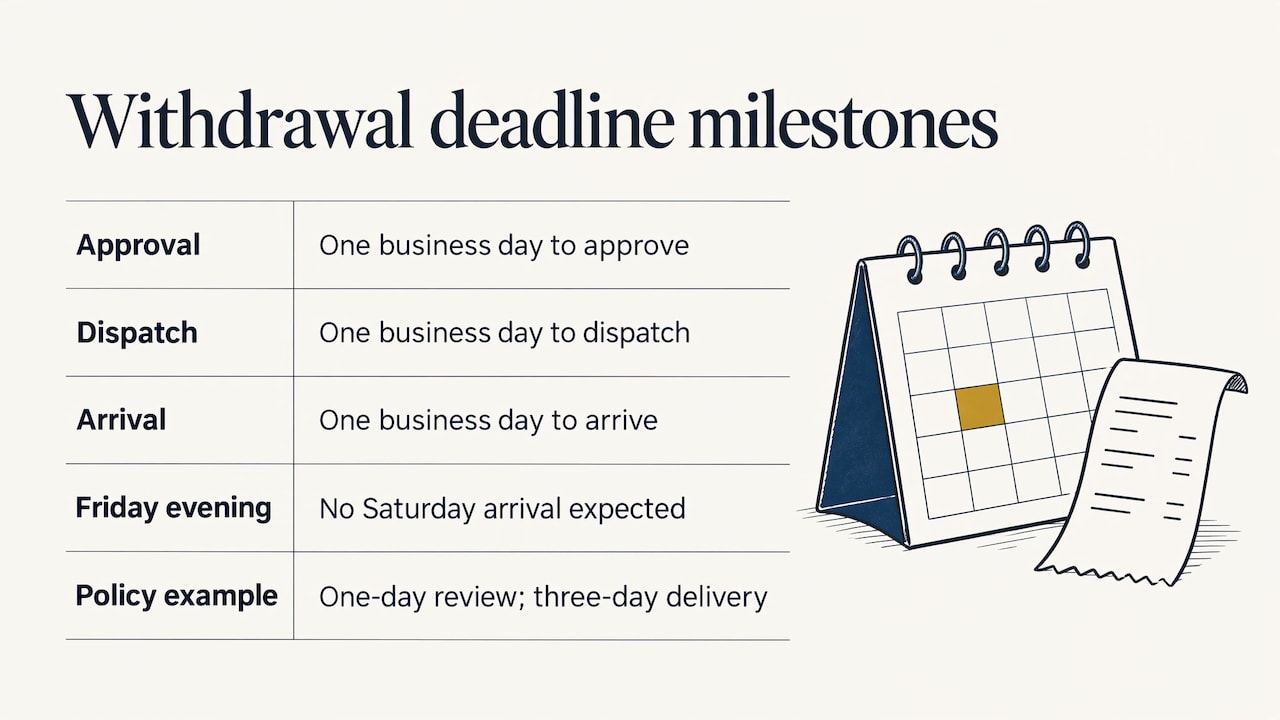
Review time versus travel time
A broker that promises “one business day” may mean one day to approve, one day to dispatch, or one day to arrive. These are different milestones. If you request on a Friday evening under a one-day review and three-day delivery policy, you should not expect money on Saturday. Ask support, in writing, which milestone the deadline covers. It costs nothing, and it gives you a clear date from which to measure a genuine delay.
Common causes of forex withdrawal delays
Verification and source-of-funds checks
Regulated brokers must run anti-money-laundering checks, and the first withdrawal often triggers a request for identity documents, proof of address or evidence of where the funds came from. A blurred scan, an expired document or a name that does not match the account all send the request back to the start. Upload clear, complete, current documents the first time. Our guide on why forex brokers ask for proof of funds explains what the checks are for and what usually satisfies them.
Margin, open positions and bonuses
Only free margin is withdrawable. If you ask for more than that, the request may be rejected or reduced. Promotional credit adds another layer: bonuses often come with trading-volume conditions, and withdrawing before meeting them can cancel the bonus or hold the payout. The same principle appears outside forex too, where only part of a balance can be paid out until checks and thresholds are met, as this explainer on sweepstakes withdrawal limits illustrates. For any promotion, read the eligibility, minimum deposit, expiry and withdrawal conditions before you accept it, and never treat a conditional offer as free money.
Payment-route mismatches
Brokers generally pay back to the route you funded from, and card refunds are normally limited to the amount you deposited by card. Profits above that amount may need to go to a bank account in your own name. A request sent to a third-party account, or to a wallet that does not match your verified identity, is a common reason for rejection. If a payment provider returns a “rejected” message, the cause is often an expired card, an unsupported method or a name mismatch, so retry through another verified route before escalating.
Statuses that disagree
A broker’s portal and its payment provider can show different versions of the same payout, because status updates pass between systems and can arrive late. That is why the portal may say “pending” after the money has landed, or “sent” when it has merely left the broker. Treat the status as a starting point. If a request is past its displayed estimate, contact support with the request reference and the exact status wording, and do not cancel a paid request or submit duplicates while it is still live, since that can create a second record that needs unpicking.
Bank and cross-border friction
International wires can pass through intermediary banks that deduct fees, and your own bank may convert currency at its own rate. A smaller withdrawal can lose a noticeable share of its value this way. If you trade in a currency different from your bank account, check both the broker’s conversion rate and your bank’s. For a payment sent by international wire that has not arrived after the broker’s stated period, you can ask the broker for the SWIFT payment confirmation (known as an MT103) and give it to your bank so that it can trace the transfer.
Forex deposit delays
Deposits fail or stall for a different set of reasons.
- Card declines. Some banks treat forex funding as high risk and block it based on merchant category or transaction patterns. Trying again with the same card rarely helps. Ask your bank whether it is blocking the payment, or use a bank transfer.
- Name mismatch. If the sender is not the account holder, the broker can reject and return the money, usually less any fees. Pay only from accounts in your own name.
- Missing documents. Many brokers credit deposits only after verification is complete.
- Bank transfer timing. Transfers sent after a cut-off time or over a weekend are credited on the next business day at best.
A reasonable broker states its target crediting time in its terms, often within one business day of accepting the payment, conditional on the checks passing. Compare your wait against that stated figure, not against what other traders report on forums.
What to do when a withdrawal is delayed
Work through this in order. Each step creates a record you may need later.
- Confirm the status and the date. Screenshot the request, the reference and the status. Note the time you submitted it and the broker’s stated processing period.
- Check the basics. Is the amount within free margin? Does the destination match your verified name? Are all documents uploaded and accepted? Is a bonus attached?
- Wait out the stated period. Count business days from the correct milestone, as above, and allow for weekends and bank holidays in both the broker’s and your bank’s country.
- Contact support in writing. Use the ticket or email route, not live chat alone, so there is a record. Quote the reference, the date and the status, and ask what is outstanding.
- Ask your bank or wallet. Check whether a pending or returned credit exists. For wires, request the transfer confirmation.
- Move to a formal complaint. Once the stated processing period has passed with no resolution, write a complaint. Include a dated timeline of submission, uploads, approval and promised dispatch, a clear statement of what is unresolved, the withdrawal confirmation, relevant statements and all earlier replies. Ask for a written outcome that includes the reason, the next action, the expected response date and a complaint reference.
- Escalate outside the firm. If the broker’s final answer does not resolve it, the route depends on the broker’s regulator, not on where you live.
Which route applies to you
The regulator that matters is the one that authorised the entity you actually contracted with, which is stated in the client agreement. Authorisation in one country does not carry over to another. A broker serving UK clients should appear on the Financial Conduct Authority’s Financial Services Register, where you can check the firm’s status and permissions before you deposit. If the firm is UK-authorised, a complaint that its final response does not settle can usually go to the Financial Ombudsman Service, and the Financial Services Compensation Scheme may apply if an authorised firm fails. Confirm the current limits and eligibility on those bodies’ own pages. If your contract is with an offshore entity, UK schemes may not cover you at all, which is why the entity name on your agreement matters. For card payments, your card provider may also be able to raise a dispute, so tell it early. If you cannot tell which entity holds your account, ask the broker to confirm it in writing.
Our guide to client money when a forex broker fails covers segregation of funds and what protection does and does not exist if the broker itself goes under.

Warning signs that point to something worse
Operational delays tend to be explained, dated and resolved in pieces. Fraud tends to look different. The US Commodity Futures Trading Commission warns that fraudulent forex dealers commonly refuse withdrawals until customers pay undisclosed commissions, invented taxes or further deposits, and that you should never have to pay more money to get your money back. It also notes that deposits are not protected if a dealer disappears or goes bankrupt.
Watch for these signs:
- You are asked to pay a fee, tax, “unlock” charge or additional deposit to release funds.
- The broker cannot name its legal entity or regulator, or the licence number does not match the register.
- Support goes silent after you request a withdrawal, but was quick when you were depositing.
- You are pushed to a higher account tier before you can withdraw.
- The website or domain looks like a regulated firm’s but is not. Our guide to a cloned forex broker shows how impostors copy real firms.
- You were introduced by someone you met online who is guiding your trades.
If several of these apply, stop depositing, keep every record, tell your bank and card provider at once, and report the firm to the relevant regulator. Be realistic: recovering money from an unregulated offshore dealer is often difficult, and anyone who promises guaranteed recovery for an upfront fee should be treated with the same suspicion.
Choosing a broker to avoid the problem
Most withdrawal trouble is predictable from documents you can read before depositing.
| What to check | Where to find it | Why it matters |
|---|---|---|
| Legal entity and regulator | Client agreement, FCA register or the relevant national register | Determines which complaints route and protections apply |
| Withdrawal methods, fees and timings | Broker’s withdrawal page and terms | Gives you a date to measure any delay against |
| Same-method and name rules | Payments section of terms | Predicts rejected payouts |
| Bonus conditions | Promotion terms | Can delay or cancel a withdrawal |
| Inactivity and other account fees | Fee schedule | Can reduce a balance you meant to withdraw |
| Client money arrangements | Terms and financial statements | Shows how funds are held |
Two of our guides help with the less obvious rows: broker inactivity fees and how to assess a forex broker’s financial statements. For a first pass on any firm, what to check first in forex broker reviews sets out the order we suggest.
Our perspective
We think withdrawal behaviour is the most revealing thing about a broker, and the least advertised. Spreads and platforms are easy to compare on a landing page. What happens when you ask for your money back is written in the terms and the complaints process, and that is where we point readers first.
Our editorial approach is to rely on primary documents: client agreements, regulator registers and a broker’s own withdrawal terms. We separate verified facts, company claims and our own assessment, and we name the legal entity and regulator for any broker we cover, because authorisation in one country does not apply across Europe.
We are an affiliate publication. We earn when readers click through to operators and complete qualifying actions, and we label sponsored placements clearly. Neither commission nor placement determines our rankings or conclusions. Our affiliate disclosure explains how that works.
The practical advice is simple: read the payments terms before you fund an account, keep a dated record, and treat any request to pay in order to withdraw as a reason to stop.
Evan Alexander
Compare brokers before you deposit
EuroGain Online publishes independent reviews and comparisons of forex brokers and online casinos, with regularly updated rankings and educational guides. Our broker comparison puts fees, regulation and platform features side by side, and our broker reviews set out how each firm is regulated and what its terms say about payments. Featured placements are labelled separately from editorial reviews.

If you are choosing a broker now, start at the EuroGain Online homepage and check the legal entity, regulator and withdrawal terms for each shortlisted firm. Trading CFDs and leveraged forex carries a high risk of losing money, and gambling products are for adults aged 18 and over.
FAQ
How long should a forex withdrawal take?
It depends on the broker and the method. E-wallets are generally faster than cards, and cards faster than international bank wires, but the figure that matters is the one in your broker’s terms. Count from the milestone the broker names, whether approval, dispatch or arrival, and allow for business days only.
Why does my withdrawal say “completed” but I have no money?
The status may only mean the funds left the broker, not that your bank has credited them. Status updates between brokers and payment providers can lag or disagree. Check your bank or wallet for pending items, ask the broker for the payment reference, and for wires ask for the SWIFT confirmation so your bank can trace it.
Can a broker refuse to withdraw my profits?
A regulated broker can hold a withdrawal while it completes identity or source-of-funds checks, or where you have asked for more than your free margin or have unmet bonus conditions. It should explain the reason in writing. A demand that you pay a fee, tax or extra deposit first is a fraud warning sign, not a normal condition.
Who do I complain to if the broker does not respond?
Start with the broker’s formal complaints process, then go to the body that covers the entity named in your client agreement. For a UK-authorised firm that can be the Financial Ombudsman Service. For an offshore entity, UK routes may not apply, so check the register for the regulator that authorised it.
Sources
- CFTC Customer Advisory: Eight Things You Should Know Before Trading Forex
- Financial Conduct Authority Financial Services Register
Recommended
- Exness Withdrawals: Deposits, Fees and Processing Times
- Client Money When a Forex Broker Fails
- Instant Withdrawals in Singapore: What to Check
- Cloned Forex Broker: How to Spot an Impostor
Editorial Disclaimer: This article is provided for general informational and educational purposes only and does not constitute financial, investment, legal, or gambling advice. Where relevant, gambling is intended only for adults aged 18 or over, or the higher legal age in their jurisdiction, and involves a risk of financial loss. Forex and CFD trading involve a high risk of loss, particularly when leverage is used. Regulations, product availability, fees, and promotional terms may vary by juris


