
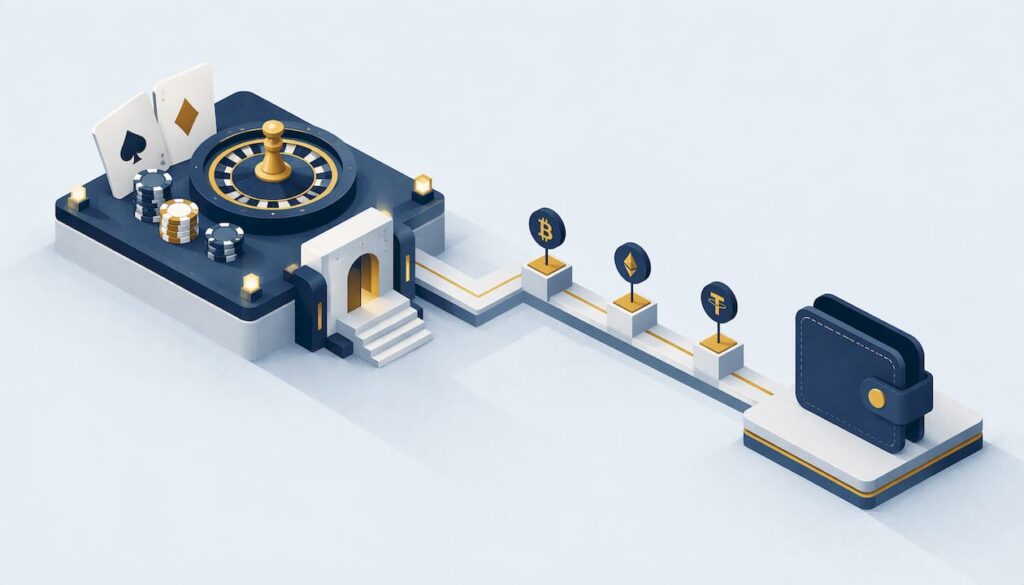
Crypto casino payments work like a bank transfer with no safety net: you send a coin over a specific blockchain network to an address the casino gives you, the operator credits your balance once it recognises the transfer, and a withdrawal runs the same route in reverse after the casino has approved it. Most problems come from three places: the wrong network, fees you did not expect, and identity checks that arrive when you ask for your money. This guide explains each, and what to verify about an operator before you send anything. Gambling is for adults only (18+). Never gamble more than you can afford to lose, and never treat it as a source of income.
TL;DR
- A crypto deposit needs the right coin, the right network and an address copied exactly. A confirmed transfer generally cannot be reversed, so a mistake can cost you the money.
- Two kinds of fee exist: the network fee, paid to the blockchain, and any fee the casino charges. Read both on the cashier page and in the terms.
- Fast blockchains do not skip the casino’s checks. Identity verification and wallet screening can still delay a withdrawal.
- Authorisation in one country does not carry over to another. Check the licence, the legal entity and whether the operator accepts players from the UK.
- Our reviews are independent of paid placements, and we disclose how the site earns money.
Table of Contents
- How a crypto casino payment actually works
- Coins and networks: the mistake that costs money
- Fees: network fee versus casino fee
- Crypto casino withdrawals, step by step
- Why the same wallet matters: closed loop and third parties
- What the rules say, and what changed recently
- Checking a crypto casino before you send anything
- Our approach to crypto casino payments
- Perspective
- Where to start
- FAQ
- Sources
How a crypto casino payment actually works
Three parties are involved: your wallet, the blockchain network and the casino’s payment system. In a typical deposit you choose a cryptocurrency in the cashier, the casino shows you a deposit address (often as a QR code), you send the funds from your wallet, the network validates the transaction, and the casino updates your balance once it has seen enough confirmations. A confirmation is another block added to the chain after the one containing your transfer. The more of them there are, the harder it is to undo the transaction, which is why operators wait for a set number.
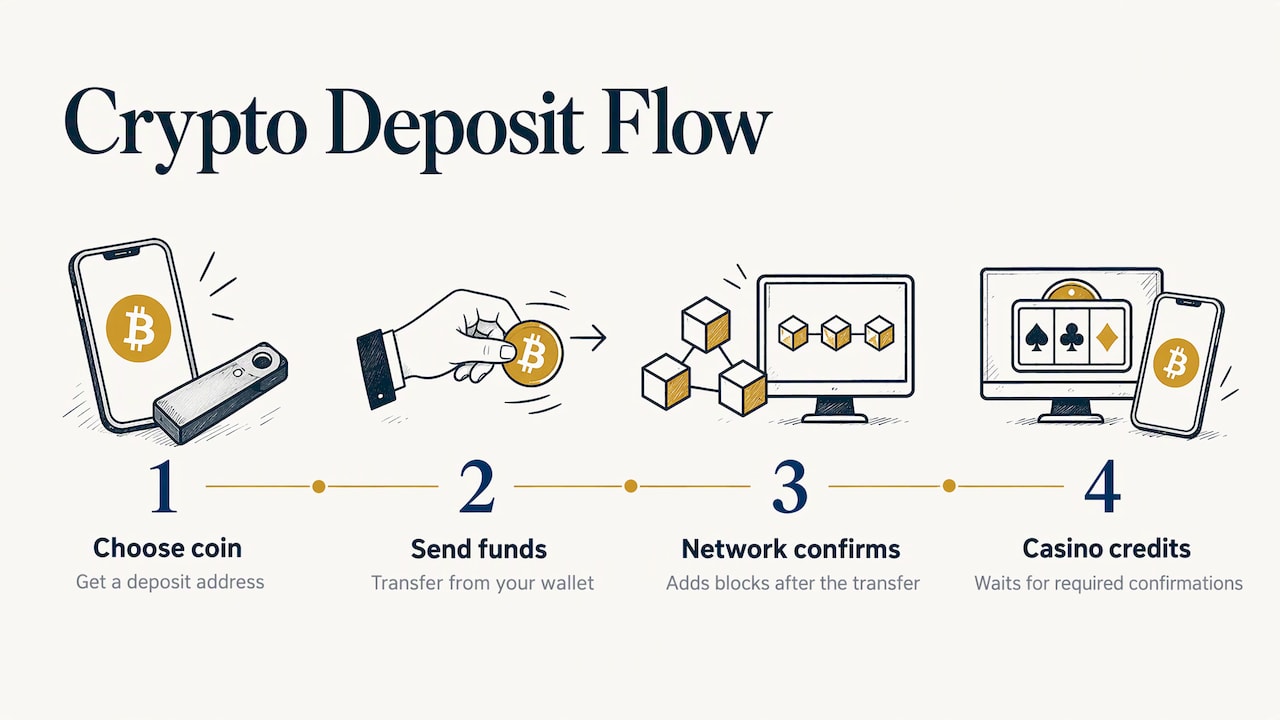
Two timings are easy to confuse. The first is when the network includes your payment. The second is when the casino credits it. A transfer can be visible on a blockchain explorer, a public website that shows transactions, while your balance still reads zero because the casino is waiting for its required confirmations.
Wallets: where the money comes from
You will normally send from one of two kinds of wallet. A custodial wallet, such as the account at an exchange, is run by a company that holds the keys for you. A non-custodial wallet is one where you hold the keys yourself. Either works for a deposit, but it matters for withdrawals. Many casinos pay out only to an address you have used or verified, and some operators check that the receiving wallet belongs to you. Researchers at the University of Nevada, Las Vegas (UNLV) describe why: linking a crypto address to a real person usually depends on the coin having passed through a compliant exchange that holds identity records, which is why regulators worry about the source of crypto funds.
If you are new to crypto, the practical point is simple: use a wallet in your own name, and keep the same one for deposits and withdrawals.
Coins and networks: the mistake that costs money
The same coin can often travel on more than one network. A stablecoin such as USDT, for example, exists on several chains, and each chain has its own address format, speed and fee. Some of these address formats look identical, so a deposit address can look right while the network is wrong. A casino will list the networks it supports for each coin on its deposit page. If you send on a network it does not process, the balance may never appear, and recovery, if offered at all, is down to the operator and its payment provider.
Before every first transfer, run through this short routine:
- Same coin. The coin in your wallet must match the coin selected in the cashier.
- Same network. Select the network in your wallet that the cashier names, not just the one that is cheapest.
- Exact address. Copy and paste it, then compare the first and last characters. Do not retype.
- Minimum deposit. Most cashiers set a minimum. Amounts below it may not be credited.
- A small test first. When you use a new wallet and casino combination for the first time, sending a small amount first costs one extra network fee and removes most of the risk.
- Gas coin. Some networks charge the fee in their own native coin. If you hold only the stablecoin and none of that native coin, you may be unable to send at all.
Online casinos that accept crypto differ in which coins they list, and the list can depend on your country. A coin that works for a player in one market may be unavailable in another, so use the cashier shown to you after you log in from the UK, not a list from a review.
Fees: network fee versus casino fee
There are two separate charges, and they are easy to mix up.
| Fee | Who receives it | What changes it |
|---|---|---|
| Network fee | Miners or validators on the blockchain | Which network you use and how busy it is; the fee you choose in your wallet |
| Casino or processing fee | The operator or its payment provider | The operator’s terms; some charge nothing, some charge a percentage or a minimum |
| Exchange spread or conversion | The exchange or the casino, if it converts | Whether your balance is held in crypto or converted to a currency such as pounds |
The network fee is set by network demand, not by the casino. Choosing a very low fee in your wallet can slow the transfer, and on busy days even a standard fee can mean a longer wait. The casino fee is stated in its terms, which is the document to read. Also check how the balance is held. If the operator converts your deposit into pounds, the exchange rate at the time of conversion matters, and you can end up with a different amount in crypto terms when you withdraw. Crypto prices move constantly, so a withdrawal can be worth more or less than the deposit even if you won or lost nothing at the tables.
A worked example makes the point. Suppose you deposit the equivalent of £100 and the network fee is £1, paid from your wallet. If the casino also charges a flat 1% on withdrawals and you withdraw £100, the casino fee is £1, and the network fee on the way out comes on top. The final amount depends on both. That is why the cashier’s fee line matters more than the headline speed.
Crypto casino withdrawals, step by step
A withdrawal is slower than a deposit in one way that has nothing to do with the blockchain: the casino has to approve it. The sequence is usually:
- Request. You choose the coin, the network and the amount, and paste your receiving address.
- Operator review. The casino checks the request against its rules. This can be automatic and quick, or it can be manual.
- Broadcast. Once approved, the casino sends the transaction to the network.
- Confirmations. The network includes it and the wallet shows the funds as available after the required confirmations.
The delay people complain about nearly always sits at step 2. A fast blockchain does not bypass the operator’s checks: know-your-customer (KYC) verification, wallet screening and sanctions checks apply to withdrawals whichever network you choose. If you have not yet verified your identity, do it before you need the money. Our guide to online casino identity checks and withdrawals lists the documents that are usually requested and why requests are sometimes repeated.
How to withdraw Bitcoin from a casino
The process is the same in outline whichever operator you use:
- Open your wallet, select Bitcoin and choose the option to receive funds.
- Copy the receiving address precisely. Some casinos ask for a new address for each request, so do not reuse an old one unless the cashier says it is fine.
- In the casino cashier, choose Bitcoin as the withdrawal method and paste the address.
- Enter the amount, in pounds or in the coin, as the cashier asks.
- Check the fee line and any wagering rule before confirming. Many operators require deposits to be wagered before a withdrawal is released, and bonus terms can add further conditions. Our explainer on cashback casino bonus terms shows how those conditions work.
- Wait for approval, then for the network confirmations. Bitcoin is generally slower and costlier than some alternatives, so expect longer than you would for a faster coin.
If a withdrawal is held for weeks without a clear reason, the operator’s complaints route and the licensing regulator are the next steps, and our page on casino account closure and held balances explains what you can ask for.
Why the same wallet matters: closed loop and third parties
UNLV’s regulator guide identifies third-party transactions as one of the biggest vulnerabilities for online casinos. A player might deposit with one payment method and withdraw to a crypto address owned by someone else. Well-run jurisdictions mitigate that by limiting depositing and withdrawing to the same method, as set out in the UNLV research on alternative payment mechanisms. For you, that translates into a rule of thumb: expect to be paid back to the wallet or method you used, and never offer your account or wallet to a friend, or use someone else’s.
What the rules say, and what changed recently
Crypto is a payment method, not a separate legal category of casino, so what matters is who licenses the operator and who it is allowed to serve.
- United Kingdom. According to a 2026 industry summary from Expert in Gaming, the UK Gambling Commission has not banned crypto, but licensees must notify it of new payment methods and reassess their money-laundering risk. A UK-licensed operator that accepts crypto is therefore working within that framework. An operator that is not licensed by the Commission cannot lawfully offer gambling to people in Great Britain, whatever coins it takes.
- European Union. The same source reports that the EU’s MiCA crypto-asset regime and the travel rule, which requires identifying information to accompany certain crypto transfers, have applied in full since 30 December 2024. Under the Fourth Anti-Money Laundering Directive, gambling providers must carry out customer due diligence on transactions of EUR 2,000 or more, single or linked. A new EU AML Regulation applies from 10 July 2027.
- Elsewhere. Rules diverge sharply. Australia banned digital currency for licensed online wagering from 11 June 2024, Brazil barred crypto-assets under an ordinance of 16 April 2024, and Curaçao’s regulator issued a crypto policy in June 2026 that prohibits wallets linked to mixers, tumblers or sanctioned addresses, according to the same summary.
The UNLV research also finds that cryptocurrency and stored value cards pose the most significant money-laundering risks for online casinos, because the real origin of funds is hard to verify. It notes that the Isle of Man regulator applies enhanced due diligence to transactions linked to anonymiser software or coin mixers and sets a lower crypto threshold of EUR 3,000. This is why you may be asked about your source of funds even on a modest account: it is the operator meeting its duties, not a sign that something is wrong.
The broader link between gambling regulation and virtual currency is explored in this piece on virtual currency in sports betting, which is useful if you also bet on sport.
Two cautions for UK readers. First, a confirmed blockchain transfer generally cannot be reversed by the sender, so card-style chargebacks do not exist here. Second, some UK banks may query or block payments to crypto exchanges. If your bank refuses a payment, speak to the bank. Do not look for a workaround that involves someone else’s account.
Checking a crypto casino before you send anything
Before a first deposit, confirm the following, and write down what you find:
- Legal entity. The company name in the footer and terms, and where it is registered.
- Regulator and licence number. Look the number up on the regulator’s own public register, not just the badge on the casino’s site. For the UK, that register is the Gambling Commission’s.
- Whether it takes UK players. A licence from one country does not authorise play in another. Never assume authorisation in one country applies throughout Europe or the UK.
- Crypto terms. Which coins and networks, the minimum deposit, the fee line, whether balances are held in crypto or converted, and the withdrawal limits.
- Withdrawal conditions. Wagering rules, verification before payout and any pending period.
- Complaints route. Who handles disputes, and what happens if the operator becomes unresponsive.
Our checklist for choosing an online casino covers the general version, and our guide to online casino blacklists shows how to check an operator’s record before you deposit. For a worked example of a licence and payout review in the UK, see our Casumo review.
Our approach to crypto casino payments
EuroGain Online is an independent review and education publication. We compare more than 100 casinos and 50 brokers, and our rankings are editorial: paid placements do not influence them. Where a casino or broker pays for a featured position, we label it and keep it separate from the review. The site earns money from referral links and clearly labelled sponsored placements, and our affiliate disclosure explains how.
For each operator we look at its legal entity, regulator and licence status, the published payment terms and the restrictions that apply to players from your country. We state what comes from a regulator or a company’s own terms, and what is our editorial opinion.
Perspective
Crypto changes who carries the risk in a payment. With a card, the bank sits between you and a mistake. With a coin, you are the safeguard: the network, the address and the amount are all yours to get right.
That is why we put payment terms at the centre of a review rather than a footnote. A cashier page that names each network, states its fees and explains how balances are held tells you something about how an operator treats its players. A page that hides these details tells you something too.
Our rankings are editorial and are not set by commercial relationships. We read the terms, check the licence on the regulator’s register and tell you which parts are company claims and which are verified. If you take one habit away, make it this: read the withdrawal conditions before the deposit button.
Evan Alexander
Where to start
If you are comparing operators, start with our casino reviews, where licence status, payment terms and withdrawal conditions are set out for each operator. Our reviews are independent and sponsored placements are labelled. For wider reading, our guides cover bonuses, verification and responsible play.
Bonuses are conditional offers. Check eligibility, wagering requirements, minimum deposits, expiry dates and geographical restrictions on our bonuses page before you accept one. If gambling stops being fun, use the deposit limits and self-exclusion tools your operator provides, and contact GamCare on 0808 8020 133 for free support in the UK.
FAQ
Are crypto casinos legal for UK players?
The Gambling Commission has not banned crypto as a payment method, but a UK licensee must notify it of new payment methods and reassess its money-laundering risk. An operator without a UK licence cannot lawfully offer gambling to people in Great Britain, so check the licence on the Commission’s register.
How long do crypto casino withdrawals take?
The blockchain part usually takes minutes to hours depending on the coin and network. The longer wait is usually the casino’s own review and identity verification, which apply however fast the network is. Verifying your account early removes most of that delay.
What happens if I send crypto on the wrong network?
The deposit may not be credited, and a confirmed transfer generally cannot be reversed by you. Whether the operator can recover it depends on its payment provider and is not guaranteed. Match coin, network and address before sending, and send a small test amount first.
Do crypto casinos charge fees?
You pay a network fee from your wallet on every transfer. The casino may add its own fee or convert your balance at an exchange rate. The cashier and the terms state which applies, so read them before confirming.
Sources
- Expert in Gaming: iGaming payments and crypto rules (2026)
- UNLV International Center for Gaming Regulation: Online casinos, alternative payment mechanisms and financial crime risks
Recommended
- Online Casino Identity Checks: Withdrawal Guide
- Casino Customer Support: What Good Looks Like and How to Use It
- Casino Account Closure: Can the Operator Keep Your Balance?
Editorial Disclaimer: This article is provided for general informational and educational purposes only and does not constitute financial, investment, legal, or gambling advice. Where relevant, gambling is intended only for adults aged 18 or over, or the higher legal age in their jurisdiction, and involves a risk of financial loss. Forex and CFD trading involve a high risk of loss, particularly when leverage is used. Regulations, product availability, fees, and promotional terms may vary by juris