

No slot machine strategy changes the odds. Every spin is decided by a random number generator (RNG), a computer routine that picks the result the moment you stake, so timing, speed, machine-hopping and betting patterns have no effect on it. What you can control is how much you stake, how long you play and which game you choose. A sensible slot strategy is therefore about cost and discipline, not about winning. This guide explains why, shows the maths on a worked example, and sets out a practical way to play slots wisely if you choose to play. You must be 18 or over to gamble in the UK.
TL;DR
- Slot outcomes are random and fixed by the machine before the reels stop, so no pattern, system or timing can beat the house edge.
- RTP (return to player) is a long-run average, not a promise for your session. A higher RTP lowers the expected cost of play but does not make a win more likely on any one spin.
- Volatility decides how bumpy a session feels: low-volatility slots pay small wins often, high-volatility slots pay rarely but can pay big.
- The only strategy that holds up is a budget and a time limit set before you start, with stake sizes that let you play the whole session.
- If play stops being fun, or you cannot stick to your limits, stop and contact a support service.
Table of Contents
- Why no slot machine strategy can change the odds
- Slot myths that cost players money
- What RTP really tells you
- Volatility: why two slots with the same RTP feel different
- A practical way to play slots wisely
- Bonuses and slots: read the terms
- Choosing where to play
- Where EuroGain Online fits in
- Our perspective
- If slots stop being fun
- FAQ
- Sources
Why no slot machine strategy can change the odds
The Responsible Gambling Council states that slot outcomes are completely random and determined by the machine’s computer before the reels stop. You cannot influence them, and over time the more you risk, the more you lose.
The Missouri Gaming Commission’s guide to how slots work explains the mechanism. The RNG cycles continuously and picks a combination at the instant a wager is committed. Modern machines also use virtual reel stops: with 256 stops per reel, a three-reel game has 16,777,216 possible combinations, far more than the symbols you can see. That is why what you see on the reels says little about the real odds, and why a machine that has not paid for a long time is not “due”.
The UK Gambling Commission makes the same point about random machines: odds stay constant and are not affected by previous wins or losses. So a system built on streaks, hot and cold spells or the last result is built on nothing.
The one exception worth knowing
Some land-based machines, such as certain progressive or accumulator games, display a visible jackpot or progress meter. For those, the state of the meter can matter to the maths. For the ordinary online video slots most UK players use, nothing you do between spins changes the house edge.
Slot myths that cost players money
Most “strategies” in search results are myths with a plausible story attached. These are the ones readers ask about most.
“The machine is due.” It is not. Each spin is independent, as the regulators above set out. For a longer look at beliefs that mislead players, see this list of common slot myths.
Near misses mean you are close. Two jackpot symbols and a third just above the line feel like a near win. The odds of the next spin are unaffected by what the last one displayed. The display is a feature of the game’s design, not a signal.
The 5-spin rule. The idea is to leave a machine if it has not paid within five spins. It has no mathematical basis. If a slot pays on 20% to 30% of spins, a five-spin dry run is entirely normal. Five spins without a win says nothing about the next five.
The “$20 method”. This popular routine sets a small stake pool, a stop-loss and a cash-out target. It is a discipline routine, not an edge. The useful parts, a fixed session amount, a hard stop and a point at which you cash out, are limits you can set on purpose without any ritual.
Time of day, or button speed. There is no hot hour. The machine’s outcome is set when you commit the bet, so pressing faster, slower or at a special time changes nothing. Real variation does exist between jurisdictions and machines in how much they return overall, but it is set by the game’s certified design, not by player behaviour.
Playing several machines at once. It does not improve your chances. Each machine keeps the same house edge, so more machines means more money staked per minute and a faster expected loss.
What RTP really tells you
RTP is the share of money staked that a game is designed to pay back as prizes over a very large number of plays. The UK Gambling Commission explains that it is an average achieved over a significant number of plays, generally 10,000 to 100,000 games for some machine types and more for random ones. It also says a machine showing 85% RTP does not mean you will win 85p back per £1 in a session.
PlayWell, a US responsible-gambling organisation, notes that payback percentages on slot machines typically sit between 80% and 95% and that a high figure does not raise your chance of winning on any given spin. Figures vary by country and game. Online slots often publish higher numbers than land-based machines, so always read the figure in the game’s own information screen.
A worked example
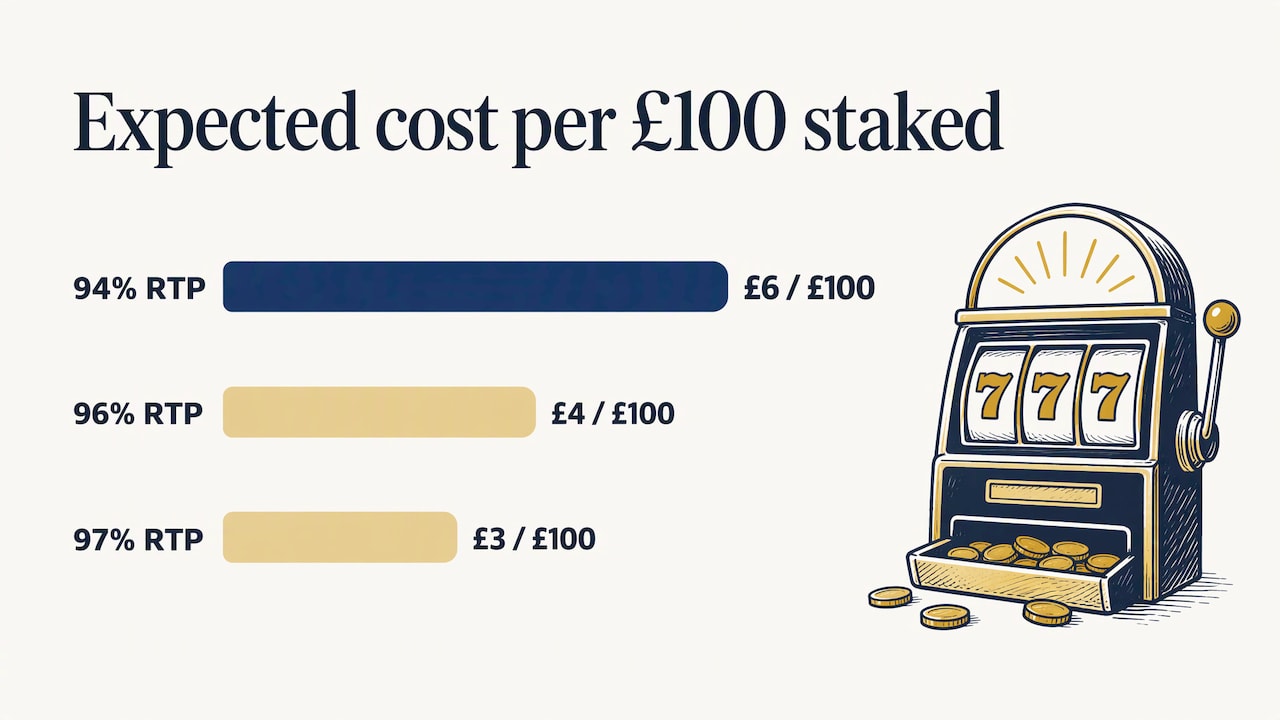
Say you play a 96% RTP slot at 50p a spin and make 200 spins. You stake £100 in total. The house edge is 4%, so the expected cost of that session is about £4. That is an average over many sessions, not a forecast. In one session you might lose the lot in 60 spins, in another you might finish well ahead. The 4% is simply the long-run price of the entertainment.
Two points follow:
- A higher RTP is better value, because the expected cost per £100 staked is lower. 94% costs £6 per £100 staked; 97% costs £3.
- Every extra spin adds to the expected cost. Faster play and bigger stakes raise the amount you stake per hour, so they raise the expected loss per hour.
That last point is why the sensible way to reduce cost is to stake less and play for less time, not to search for a clever system.
Volatility: why two slots with the same RTP feel different
Volatility (sometimes called variance) describes how a game’s return is spread out. Low-volatility slots tend to pay smaller wins often, so a bankroll lasts longer. High-volatility slots pay less often but can produce large wins, and a session can go through long dry stretches. As USA Today’s FTW guide puts it, a high-volatility game may need a bigger bankroll to ride out 30 to 50 spins without a significant win.
How to use this without treating it as a trick:
- If you want a longer, calmer session on a small budget, a low-volatility game with a small stake suits that goal.
- If you choose a high-volatility game, accept that a short budget may be gone quickly, and lower the stake so the session lasts.
- Neither type changes the expected cost. Volatility changes the shape of the ride, not the price.
Paylines and bet levels work the same way. More paylines or a higher stake per spin increase the amount you stake each spin. Check the paytable and the game information before you play so you know what each spin actually costs.
A practical way to play slots wisely
The only approach that protects you is a set of limits decided before the first spin. Treat it as a plan for how you spend an evening, not a plan for winning.
- Decide the budget first. Use only money you can afford to lose, and which is not needed for rent, bills or savings. The Victorian (Australia) regulator’s lower-risk guidelines suggest no more than 2% of take-home pay, no more than once a week and on no more than two types of gambling product. On a £1,000 weekly take-home, that would be £20. These are Australian guidelines, but they give a useful yardstick.
- Set a time limit. Slots are built to keep a fast rhythm. Pick a session length and use a timer.
- Use the operator’s tools. iGaming Ontario’s player guide describes deposit, loss and time limits that can be set over 24 hours, seven days or a month. UK-licensed sites offer similar tools, so set them up before you deposit, while you are calm.
- Size the stake to the session. Divide the session budget by the number of spins you want. £20 across 100 spins means a 20p stake. If the stake would end the session in ten minutes, lower it.
- Pick the stop points in advance. Decide the loss at which you stop and, if you wish, an amount at which you cash out. Writing both down before you start is the sound part of routines such as the $20 method.
- Never chase losses. Raising stakes or topping up to win money back does not improve the odds on the next spin. It only raises the amount at risk.
- Skip play when upset or after drinking. Official guidance for new players advises avoiding gambling when upset or impaired by alcohol, and being realistic that over the long run you will lose more than you win.
- Try a free version first. Where a free-play mode is offered, it is a low-cost way to learn how a game’s features work before you stake real money.
If you read a review or a bonus offer that makes slots sound like an income, treat it with caution. Gambling is not a reliable source of income, and no method makes it one.
Bonuses and slots: read the terms
Welcome offers and free spins are often tied to slots, and they come with conditions: wagering requirements, minimum deposits, expiry dates, maximum bets while a bonus is active, game contributions and country restrictions. A bonus is conditional credit, not free money. Wagering means you may need to stake the bonus amount several times before you can withdraw winnings. Our pages on casino bonus terms, cashback casino bonuses and why a bigger bonus is not always better show how to read these conditions line by line before you opt in.
A bonus does not change the odds of any spin either. It only changes how much of your own money you stake and under which conditions you may withdraw.
Choosing where to play
A strategy matters little if the site itself is unreliable. In the UK, an operator should hold a licence from the UK Gambling Commission to offer gambling to UK customers, and authorisation in another country does not carry over. Before you register, check the licence details, the legal entity named in the terms, the deposit and withdrawal rules and how support responds. Our checklist for choosing an online casino walks through those checks, and what good customer support looks like shows what to expect if something goes wrong. If you are new to casino games generally, casino games for beginners explains the main formats. Games with a card or table structure have their own odds and myths, for instance in our guide to roulette betting strategy.
Where EuroGain Online fits in
EuroGain Online publishes independent reviews of online casinos and forex brokers, with regularly updated rankings, comparisons of operator safety, reliability and product features, and educational guides. Our editorial rankings are not influenced by paid placement, and we are open about how featured listings are funded. You can read our casino reviews to compare operators, or see the affiliate disclosure to understand how the site earns money.

Start at the EuroGain Online homepage to browse casino reviews and guides. 18+ only. Gambling can harm, so play within limits you set in advance.
Our perspective
The most useful thing we can say about slot strategy is also the least exciting: the maths is fixed, so the decision that matters is made before you sit down. Choose a licensed operator, read the game’s RTP and rules, set your limits and keep them.
We would rather our readers walk away with an accurate picture than a tempting one. That is why we separate verified facts from company claims, and why a review should name the legal entity, the regulator and the licence status behind a casino. A site that cannot tell you those things has not earned your deposit.
We earn money through affiliate links and clearly labelled sponsored placements. Neither decides our rankings, ratings or conclusions, and we say so openly in our disclosure. If a page ever read like an invitation to chase a win, we would consider it a failure of our own standards.
Evan Alexander
If slots stop being fun
Warning signs include spending more than you planned, playing for longer than you meant to, chasing losses, hiding your play from others or feeling anxious when you are not playing. If any of these sound familiar, stop, remove your card details from gambling accounts and use the operator’s time-out or self-exclusion tools. In Great Britain, the national self-exclusion scheme GamStop and the support service GamCare are the places to start, and your GP can help if gambling is affecting your mental health. If you are in immediate distress, contact emergency services.
FAQ
Is there a strategy that helps you win at slots?
No strategy changes the odds, because each result is random and set by the machine when you stake. What helps is a fixed budget, a time limit and a stake that lets you play the whole session. That keeps the cost of entertainment under control, but it does not make winning more likely.
Is there a pattern to online slots?
No. Online slots use a random number generator, and the Missouri Gaming Commission explains that a machine is not “due” after a long dry spell. Streaks look like patterns because random results naturally include runs, but they do not predict the next spin.
What is the 5-spin rule on slots?
It is the belief that you should leave a machine if it does not pay within five spins. It has no mathematical basis: if a slot pays on 20% to 30% of spins, five losing spins in a row happen regularly on a perfectly normal machine. Your session budget is a better reason to stop than a spin count.
How should a beginner play slot machines wisely?
Decide how much time and money you will spend before you start, and use only money you can afford to lose. Set deposit, loss and time limits with the operator, choose a stake that fits your budget, check the RTP in the game information and stop when the limit is reached. Treat slots as paid entertainment, not as a way to make money.
Sources
- Common Myths about Gambling, Responsible Gambling Council
- The Truth About Slot Machines, Missouri Gaming Commission
- Return to player: how much gaming machines payout, UK Gambling Commission
- The Science of Slots, PlayWell
- How to Play Online Slots for Real Money, USA Today FTW
- New to iGaming? iGaming 101, iGaming Ontario
- Slot Myths Busted: 9 Beliefs That Cost Players Money
Recommended
- Roulette Betting Strategy: What Works, What Doesn’t
- Casino Games for Beginners: Where to Start and What to Know
- Bigger Casino Bonus: Why Size Isn’t Everything
Editorial Disclaimer: This article is provided for general informational and educational purposes only and does not constitute financial, investment, legal, or gambling advice. Where relevant, gambling is intended only for adults aged 18 or over, or the higher legal age in their jurisdiction, and involves a risk of financial loss. Forex and CFD trading involve a high risk of loss, particularly when leverage is used. Regulations, product availability, fees, and promotional terms may vary by juris


