
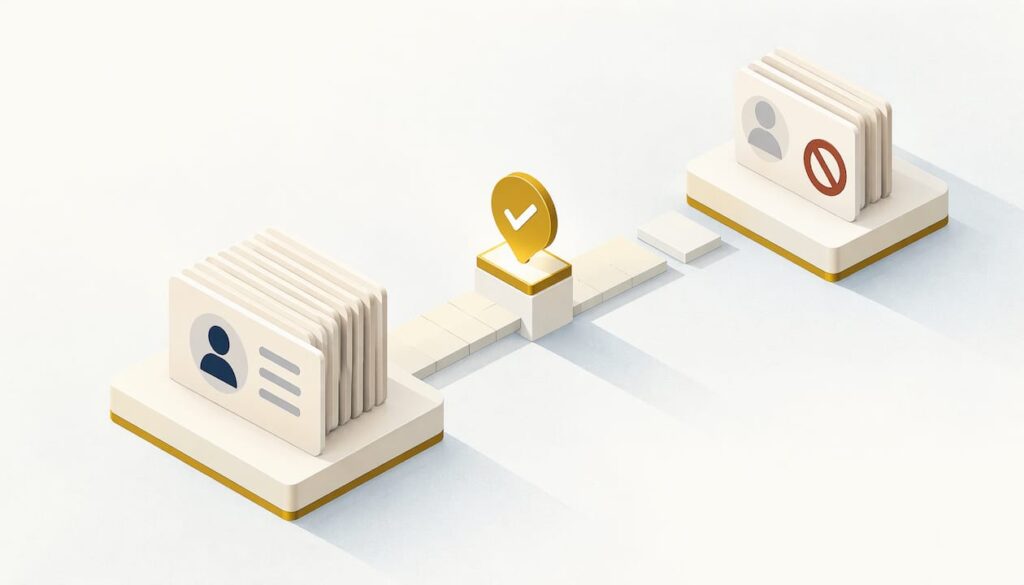
An online casino blacklist is a list of gambling sites that a regulator or a review publisher warns players about. The two kinds are not equal. A regulator’s list is a legal statement about who may operate in its country. A publisher’s list is an editorial opinion. The reliable way to use either is to check the casino against the licensing register for your own country before you register or deposit, and to treat every blacklist as a starting point for that check, not the end of it.
This guide is for readers in the UK and elsewhere who want to understand what “blacklisted” really tells them. It covers why sites end up on lists, how to check one yourself, and what to do if a casino holds your money. Gambling is for adults only (18+ in the UK), and nothing here is a way to make money. If gambling is causing you harm, the UK’s BeGambleAware and the National Gambling Helpline (0808 8020 133) offer free, confidential support.
TL;DR
- A blacklist is either a regulator’s warning or blocked list (a legal position) or a publisher’s rating (an opinion). Know which one you are reading.
- Being on a regulator’s list usually means the operator is not authorised in that country. It does not by itself prove fraud, and it does not prove a site will refuse to pay.
- Licences are territorial. A licence from one country does not authorise a casino to serve players in another.
- For UK players, the quickest check is the Gambling Commission’s public register: the business, its domain names and its permitted activities should all match.
- If a site is unlicensed, you lose the protections that come with a licence, including a regulator complaint route, so the safest step is not to deposit.
Table of Contents
- What an online casino blacklist actually is
- Why casinos end up on a blacklist
- What “blacklisted” does and does not tell you
- How to check a casino yourself, step by step
- Warning signs that appear before any list does
- Licensed in one country, listed in another
- If a casino keeps your money
- Can a casino come off a blacklist?
- Our offer: reviews built around the checks above
- Perspective: why a list is only the start
- FAQ
- Sources
What an online casino blacklist actually is
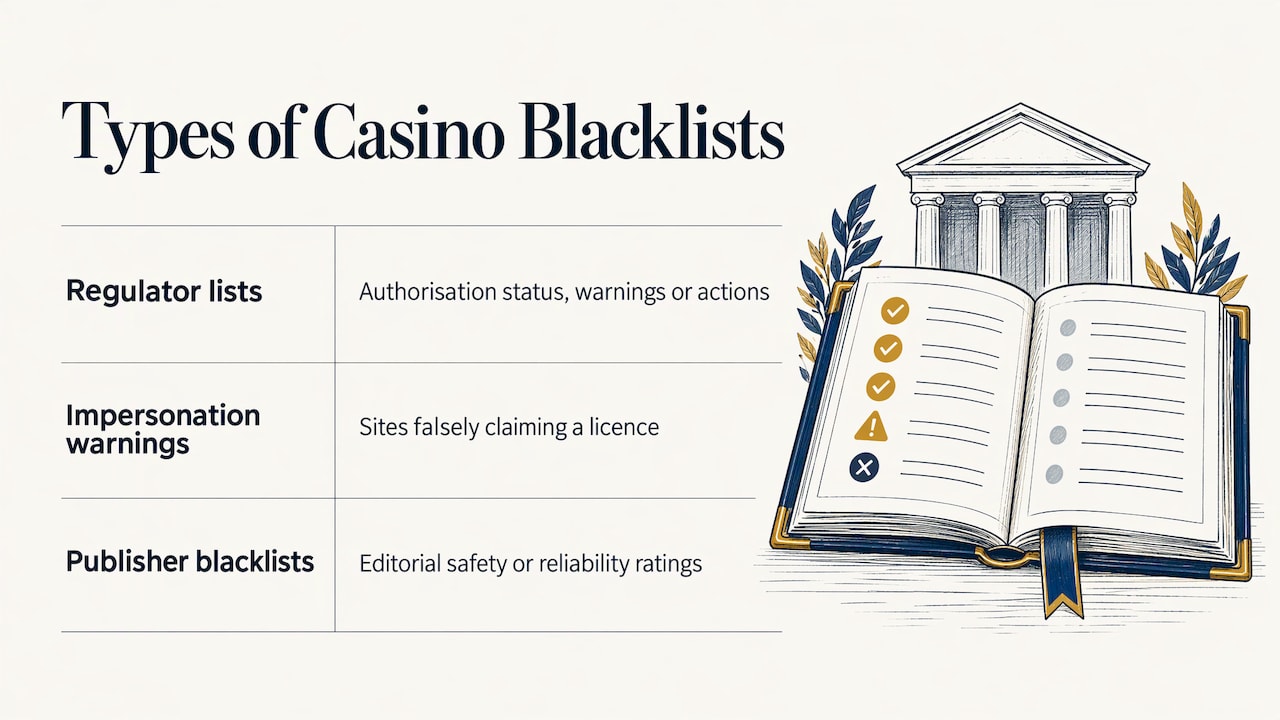
The word “blacklist” is used loosely. In practice, three different things sit under it.
Regulator lists. Many regulators publish warnings, blocked-site lists or registers of authorised operators. In Poland, for example, the Ministry of Finance keeps a public register of domains and lists of legal operators, and has warned that a licence from another country does not legalise gambling in Poland. In the UK the Gambling Commission takes the opposite approach: its public register shows licensed businesses, individuals and premises, plus regulatory actions such as sanctions and settlements. So in the UK, the strongest signal is often absence from the licensed list, not presence on a banned one.
Impersonation warnings. Regulators also name sites that falsely claim to be licensed. On 16 July 2026 the Malta Gaming Authority named three websites as impersonating MGA licensees and said it had no connection with them. The lesson is that a licence badge in a site footer proves nothing until you have matched it to the official register.
Publisher blacklists. Review sites, including ours, may rate operators as unsafe or unreliable. These are editorial assessments. They are useful when the publisher explains the evidence behind each rating, such as licence status, terms, complaint patterns and payout conduct, and they are weak when they do not. We disclose how we earn money on our affiliate disclosure page, and our editorial rule is that commissions and sponsored placements never decide a rating or ranking.
Why casinos end up on a blacklist
The reasons fall into a handful of groups, and they carry very different weight for a player.
| Reason | What it means | How serious for you |
|---|---|---|
| No licence in your country | The operator is not authorised where you live | High: you lose local protections |
| Impersonating a licensee | The site copies a real operator’s name or licence details | Very high: treat as a scam risk |
| Regulatory action against a licensed operator | A sanction or settlement appears on the register | Depends on the reason; read the notice |
| Payment or terms complaints | Publisher or regulator has recorded disputes over withdrawals or bonus rules | Varies; check the details |
| Blocked by a national authority | The country has ordered the site to be blocked | High within that country |
The national blocking route is growing. India’s IT ministry reported that it had blocked or otherwise actioned 8,376 betting and gambling website URLs as of 28 March 2026, and the Indian Act and its Rules came into force on 1 May 2026. That is one country’s regime. It says nothing about the legal position in the UK or anywhere else.
What “blacklisted” does and does not tell you
This is where players most often go wrong, in both directions.
An unauthorised-operator entry on a regulator’s list means the operator is not authorised in that regulator’s jurisdiction. According to coverage of the international regulators’ site-checking tool, that status does not on its own establish that a site is fraudulent or that it will fail to pay. It does mean the operator is outside that country’s rules, and the Malta regulator is clear about what follows: unlicensed entities are unregulated, lack the safeguards of its framework and make transactions risky for consumers.
In plain terms, a site on a warning list may or may not steal your money, but if something goes wrong you have far fewer places to turn. Michigan’s Gaming Control Board put the same point concretely on 10 November 2026: illegal sites are not subject to protections on age verification, safeguards for player funds and personal data, responsible-gambling tools and a complaint route to the Board. Those are US rules, but the logic travels: what you lose is the safety net.
There is also a legal side. Poland’s Ministry of Finance said on 13 June 2023 that taking part in illegal gambling can have legal consequences. That warning is specific to Poland and should not be read as the position in other countries, but it is a reminder to check the rules where you live.
How to check a casino yourself, step by step
For a UK player, this takes about ten minutes and is more reliable than any list.
1. Find the licence details on the site
Look in the footer or terms for the operator’s company name, licence number and the regulator named. Write down the company name and the exact domain you are on. If there is no company name at all, stop there.
2. Match them to the Gambling Commission register
The Commission’s guidance says to check that the business holds a British licence and that its address, website domain names, trading names, current licence status and permitted activities match the public register. The register can also show what activities a business may offer and whether regulatory action has been taken against it. A casino holding only an offshore licence can be perfectly legal in its home country and still not be authorised to serve UK customers.
3. Check for foreign licences on the right register
If a site cites a Malta, Isle of Man or other licence, search that regulator’s own register, not a link supplied by the casino. The Malta Gaming Authority directs consumers to its official Licensee Register. The Isle of Man’s Gambling Supervision Commission describes licensing as ongoing supervision, including inspections, remediation monitoring and complaint handling, which is why the live register matters more than a logo. Remember that a licence from one place does not make a brand legal everywhere.
4. Try the multi-regulator lookup
Michigan’s regulator reported on 10 November 2026 that CheckBeforeYouPlay.org lets you enter a gambling site’s URL and see available licensing information for participating member jurisdictions. It only covers participating regulators, so no result is not the same as a clean bill of health.
5. Read the bonus and payment terms
The Gambling Commission advises checking bonus restrictions and terms and conditions, including minimum spend and wagering-related requirements, before accepting any offer. Wagering requirements, expiry dates, maximum bet limits and withdrawal conditions are where most disputes begin. Our bonuses page explains how to read those conditions, and an offer is never free money: it is a conditional deal.
6. Confirm the safety tools exist
UK-licensed online sites must offer tools to set limits and control time and money spent, and the Commission also describes account history and self-exclusion as protections. If a site has none of these, that is a sign it is not operating under UK rules.
We set out the same checks as a longer list in our guide on how to choose an online casino, and you can see how we apply them to specific operators on our casino reviews page.
Warning signs that appear before any list does
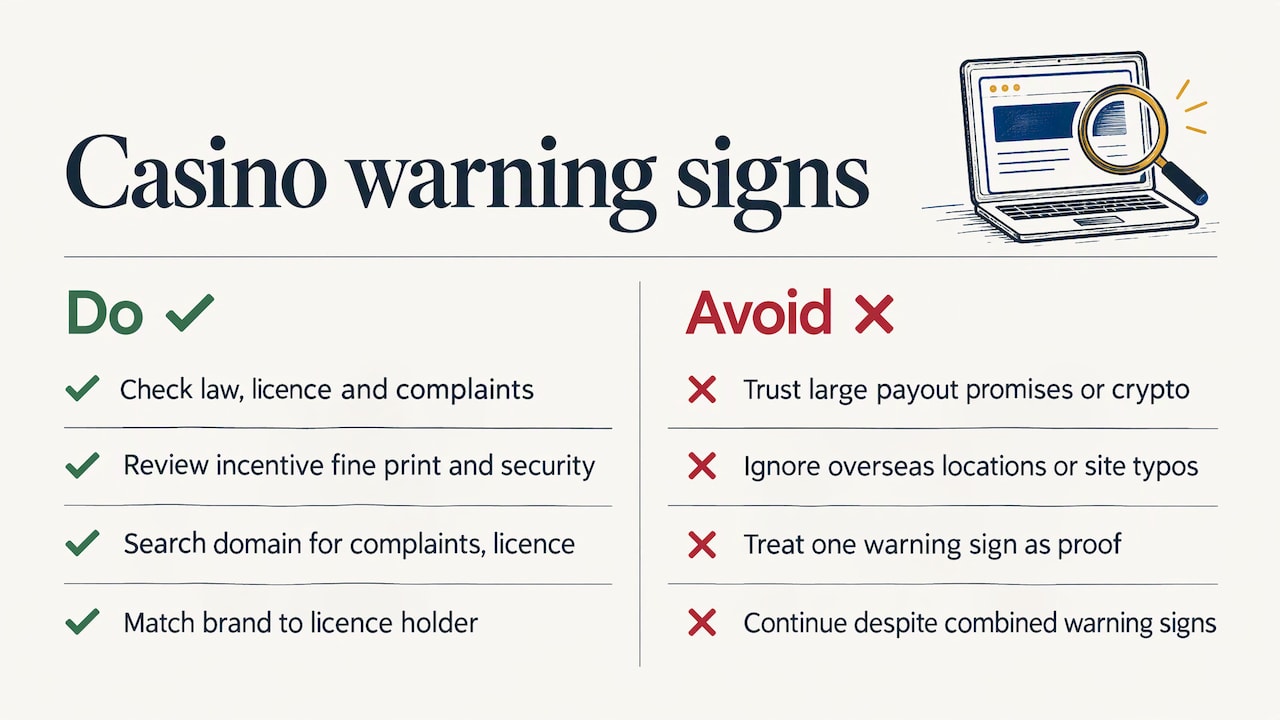
New sites appear faster than lists can be updated, so it helps to recognise the patterns yourself. The Better Business Bureau’s investigation into unlicensed casinos and sportsbooks suggests checking state or provincial law, licensing, complaints, incentive fine print and website security. It identifies large payout promises, payment in cryptocurrency, overseas locations and typos in the site’s name as possible warning signs. None is proof alone. Together they justify stopping.
A practical test: search the exact domain name beside the words “complaints” and “licence”, and compare the spelling of the brand with the licence holder on the register. Cloning is not unique to casinos; we explain how copycat brands operate in trading in our piece on cloned forex brokers, and the same habit of checking the legal entity applies.
Licensed in one country, listed in another
Because authorisation is territorial, one brand can be licensed in one jurisdiction and appear on another’s warning or blocked list. The coverage of the international regulators’ lookup tool cautions that a foreign licence does not automatically authorise operation elsewhere. Poland shows how this works in practice: its ministry said that its legal offer differs by product, naming a single legal online casino operator while betting operators need Polish authorisation.
The worked example: imagine a casino that displays an offshore licence and accepts UK sign-ups. The offshore register may show a valid licence, which is true. But if the Gambling Commission register has no entry for the business and its domain, it is not a UK-authorised operator. The correct reading is “licensed elsewhere, not authorised here”, and the protections a UK player expects do not apply.
If a casino keeps your money
Act in this order and keep records throughout.
- Save evidence. Take screenshots of your balance, the terms you accepted, chat logs and transaction records.
- Complain to the operator first. Regulators generally expect you to try. For certain complaints involving Isle of Man licensees, the Gambling Supervision Commission accepts complaints after the customer has tried and failed to resolve the issue with the licensee. Our guide to casino customer support explains how to write a complaint that is easy to resolve.
- Use the regulator or dispute route that matches the licence. This depends on who licensed the site, which is exactly why the register check comes first. The Isle of Man commission also says its online licensees serving recreational customers must arrange safeguards for deposits, unpaid winnings and redeemed bonuses if the licensee ceases operating.
- Contact your payment provider. Tell your bank or card issuer what happened. This is a consumer step, not a casino-specific one, and the outcome depends on your provider’s rules.
If the operator is unlicensed in your country, the regulator may have no power to act for you, which is the practical cost of using such a site. Do not send more money to “release” a withdrawal, and never chase losses by depositing again.
Can a casino come off a blacklist?
It depends on whose list it is. A regulator’s entry is tied to authorisation: if an operator obtains a licence in that jurisdiction, the legal position changes and the register should show it. We found no official source that sets out a standard delisting process across regulators, so treat any publisher’s claim of a “clean slate” with care.
What you can look for are verifiable changes: a current licence on the relevant register matching the company and domain, a closed or fully explained regulatory action, clear and fair terms, and a record of complaints being resolved. Time matters too, because the Isle of Man commission’s description of supervision as continuing, not a one-off badge, applies equally to the evidence you gather. A site that changes its name after complaints should be checked as a new business.
Our offer: reviews built around the checks above
EuroGain Online publishes independent reviews of online casinos and forex brokers in Europe, with regularly updated rankings, comparisons of operator safety, reliability and product features, and educational guides. Where a review covers a casino, it states the operator, its licence position and the bonus terms, so you can compare them against the register yourself. The site compares more than 100 casinos and 50 brokers.
If you want to see what a licence-and-terms review looks like, start with our casino reviews, for example the 888casino review or the Casumo review. Featured placements on the site are funded by operators and are labelled as such, kept separate from editorial ratings. You can browse everything from the EuroGain Online home page.
Perspective: why a list is only the start
Readers often ask us for a single list of casinos to avoid. We understand the appeal, but we think a blacklist is most useful as a prompt to check, not as a verdict.
The reason is simple. A regulator’s list answers a legal question for one country. A publisher’s list answers a quality question for one author. Neither can tell you whether the site in front of you, today, matches a live licence in the place you live. That is why we focus our reviews on the evidence a reader can verify: the legal entity, the regulator, the licence status, the bonus conditions and the way complaints are handled.
We earn money through affiliate links and labelled sponsored placements, and we say so openly. Our rule is that this income does not decide a rating, a ranking or a conclusion. We would rather a reader spend ten minutes on a register than trust any list, ours included, without checking it.
Gambling is for adults and carries a real risk of loss. It should never be treated as a source of income.
Evan Alexander
FAQ
How do I know if a casino site is legit?
Check that the operator holds a licence from the regulator for your country, and match its company name, domains and permitted activities to the public register. For UK players that means the Gambling Commission register. Then read the bonus and withdrawal terms before you deposit.
Does a blacklisted casino always steal your money?
No. A regulator listing an operator as unauthorised means it is outside that country’s rules, not that it is a fraud. The real problem is that if there is a dispute, you have fewer protections and a weaker route to a remedy. That is reason enough to avoid depositing.
Is there a way to get money back from an online casino?
Sometimes. Start with a written complaint to the operator, keep all evidence, and then use the regulator or dispute route that matches the licence. Contact your bank or card provider as well. If the site is unlicensed in your country, recovery is much harder.
Do casinos ask for ID?
Licensed casinos do, because age and identity checks are part of operating legally. Michigan’s regulator lists age verification among the protections that illegal sites do not provide. A site that never asks for any verification is not following the standard a licensed operator must meet.
Sources
- Gambling Commission: What to look at before you gamble
- Gambling Commission: How gambling companies keep you safe while betting online
- Gambling Commission: Public register of licensees, premises and regulatory actions
- Malta Gaming Authority: notice on websites impersonating licensed operators
- Michigan Gaming Control Board: Illegal Gambling Awareness Week
- Polish Ministry of Finance: warning on illegal operators
- Isle of Man Gambling Supervision Commission: Player protection principles
- Coverage of the global regulators’ site-licence checking tool
- Better Business Bureau: investigation into unlicensed online casinos
- India MeitY blocking report, 2026
Recommended
- How to Choose an Online Casino: A Checklist for UK Players
- Casino Customer Support: What Good Looks Like and How to Use It
Editorial Disclaimer: This article is provided for general informational and educational purposes only and does not constitute financial, investment, legal, or gambling advice. Where relevant, gambling is intended only for adults aged 18 or over, or the higher legal age in their jurisdiction, and involves a risk of financial loss. Forex and CFD trading involve a high risk of loss, particularly when leverage is used. Regulations, product availability, fees, and promotional terms may vary by juris


